Formnext 2026: Metal Printing, Casting and Application-Led Additive Manufacturing
- DEVELOP3D
- 720 reads
Formnext 2026 highlighted niche materials, desktop steel printing, jewellery production and additive systems built around specific manufacturing needs.
Formnext 2026 pointed to a more focused role for additive manufacturing: specialised materials and production needs are shaping machines and processes, while application-led businesses are finding clearer routes into manufacturing. Across Frankfurt’s trade fair, the examples ranged from tungsten alloys and ceramic casting cores to desktop steel printers, jewellery and hardware for AI data centres.
Specialist materials find their place
Additive manufacturing can make parts from materials that are difficult to process through conventional routes, either by printing the final component or by producing a pattern or mould for casting. Tungsten based metals drew attention, with 3D Systems among the companies working in this area. These materials may suit industries prepared to pay for specialised performance, and suppliers are working with customers to develop and qualify processes.
Ceramics remain another active area. Lithoz reported sales of three industrial printers to Boom Aerospace for making complex casting cores used in single crystal turbine blades. Hydra Manufacturing, a University of Leeds spin-out, showed a hybrid ceramic process that combines additive production with precision machining before firing. That sequence aims to pair geometric freedom with detailed finishing.
Printing patterns and moulds for casting is less conspicuous than printing finished parts, but it already fits into large foundries’ workflows. The applications span large sand castings, wax patterns and resin tooling made on large stereolithography systems. As wax printers grow in scale and casting resins expand, additive methods can support intricate or specialised work without requiring a foundry to replace its broader process.
Steel printing moves towards the workshop
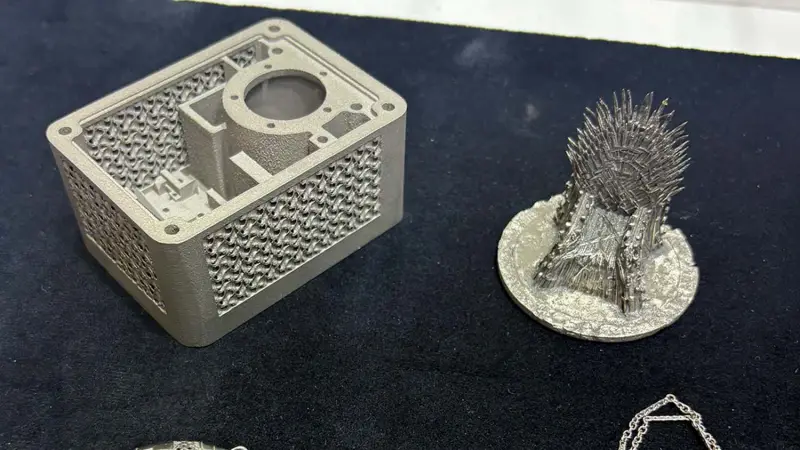
The SnowPod from SnowX puts metal printing into a desktop format. A decade ago, the $1,750 Makerbot Replicator helped bring plastic part printing to a wider audience. Adjusted to roughly $2,570 today, that price provides a useful comparison: the SnowPod is presented at about twice that amount, with steel as its material.
Interest at the SnowX stand was high. Parts straight from the printer showed a surface finish below that of machines costing far more, but the postprocessed samples on display made a stronger case for the system. SnowX is developing additional materials, and a heavily oversubscribed Kickstarter indicates substantial demand. If the machine delivers on its promise, it could bring metal prototyping within reach of more workshops.
SnowX CEO Fangda Xu spent nearly a decade studying and developing additive manufacturing technology and processes in the UK before returning to China to build the company. His path also points to a wider challenge: technical talent can develop locally, yet still struggle to find the support needed to turn that work into an industrial business.
Jewellery production gets more options
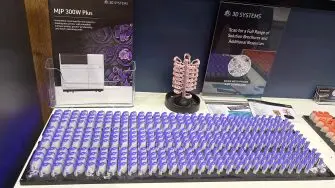
Lost wax casting has relied on 3D printing for years, but current systems offer more build capacity and accessible entry points. 3D Systems doubled the build area of its updated MJP 300W Plus, a wax printer used for casting that can also support detailed parts for industrial applications.
Formlabs showed the Form Studio 1, an entry level machine developed in part around the company’s casting materials. At £658, it gives small jewellery studios a comparatively accessible way to make patterns. The crowd around the machine included jewellery designers, reflecting the practical appeal of a compact setup.
Direct metal printing offers another route: parts can be made without moulds, multiple custom designs can share a build, and high density components can reduce downstream work such as soldering. The displayed process was described as achieving 99.8% density and 99% powder reuse. Those characteristics, combined with less material waste, may help the economics compete with traditional production, particularly when precious metal prices are high. Digital files also make it easier to change designs and shift production.
Legor, a materials science group that produces powders for sintering, showed jewellery made through metal additive processes and continues to work with HP MetalJet and Stratasys backed Tritone MoldJet. XJet is also applying its NanoJet process to jewellery, drawing on its smooth surface finish and straightforward postprocessing. The company has opened a consumer service for designing custom pieces with generative AI, with XJet handling production and shipping.
Manufacturers are choosing applications first
The broad promise of a printer that can serve every need is giving way to more specific applications. Metals already have established demand in sectors such as energy and aerospace. Polymer printing still has to show where it can compete with established processes such as injection moulding.
Carbon has built its business around defined products and partners, including Adidas, Riddell and bicycle seat manufacturers. Its work with sports equipment companies applies design for additive manufacturing to production parts. At Formnext, Vivobarefoot showed how phone based foot scanning could simplify the custom footwear process, adding a digital route into Carbon’s production ecosystem.
Stratasys is also concentrating on manufacturing use cases. It has identified four focus areas: aerospace, defence, automotive and medical, while moving away from general prototyping as its central pitch. The company’s F870 and H550 printers illustrate the shift, with the F870 aimed at factory jigs and fixtures and the H550 at automotive work. The strategy gives buyers a clearer application story, though matching a broad machine portfolio to a smaller set of use cases may take careful positioning.
AI infrastructure is creating new hardware demands
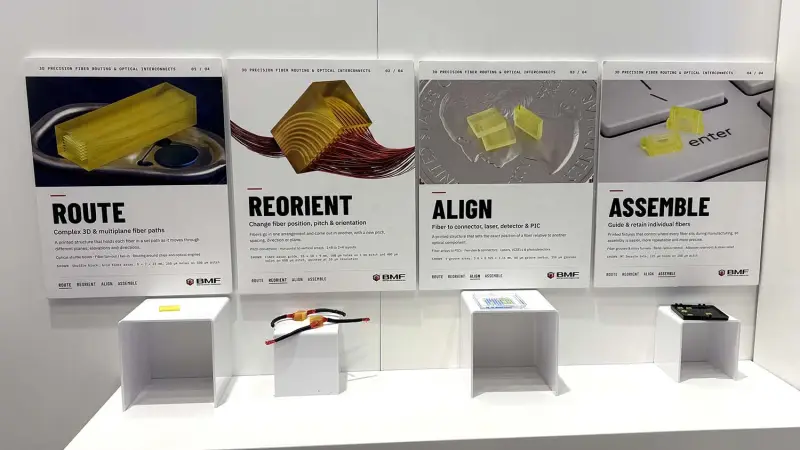
Demand tied to AI data centres is bringing additive manufacturing into both precision components and large power equipment. At the small scale, routers and connectors must fit dense fibre optic assemblies. Cooling panels designed with generative methods offer another opportunity to shape parts around airflow and packaging constraints.
Boston Micro Fabrication (BMF) is working at the precision end. Its microArch S150 Ultra is specified to print with four micron accuracy, while offering nearly nine times higher throughput than its prior level. That combination could matter for the small, detailed parts used in data centre hardware.
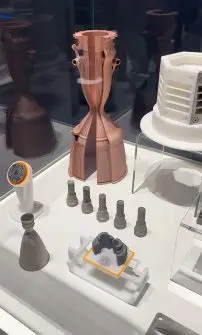
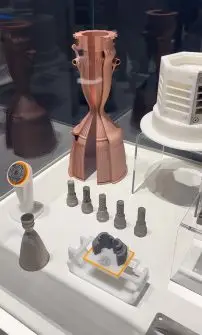
Power supply creates a much larger manufacturing challenge. Several exhibitors showed large turbine components made through additive casting, connecting the technology to efforts to develop electricity generation equipment more quickly.
Software is changing how existing machines are used, too. AI assisted build setup and process monitoring can help operators improve print success. Some firms are also upgrading used printers with newer components and revised software. German bureau Visiotech, for example, reworks machines to support elements such as more powerful lasers and coaters. As manufacturers seek extra capacity at lower cost, the market for older equipment could grow; the next test is whether vendors support that route and make upgrades practical.