Connected Mining Systems Forecast to Reach 3.1 Million Units by 2030
- IoT.Business.News
- 961 reads
Berg Insight forecasts 3.1 million connected mining units by 2030, with growth spanning equipment, worker safety, environmental monitoring and automation.
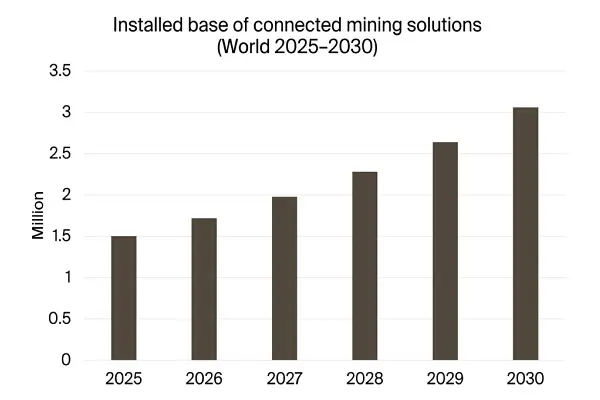
Connected mining is expanding from equipment tracking into systems that can shape decisions about worker safety, site conditions and machine operation. Berg Insight estimates the worldwide installed base of connected mining solutions at 1.5 million units in 2025 and forecasts approximately 3.1 million by 2030, a compound annual growth rate of 15.3% over that period.
That forecast captures a shift in the role of industrial connectivity at mine sites. Telematics can report how equipment is being used; worker monitoring and environmental sensors add information about people and operating conditions. When these data streams connect with automation systems, they can support applications such as collision avoidance, fatigue monitoring, ventilation on demand and situational awareness. The practical value depends on whether the information reaches the right systems reliably enough to inform operations.
Equipment remains the largest segment
Berg Insight groups connected mining into three segments: equipment, people and environment. Equipment is the largest, covering original equipment manufacturer telematics on mining vehicles and machinery, along with systems from specialist technology suppliers. The people segment includes tools intended to support worker safety and productivity. Environmental solutions use sensors to monitor conditions at mine sites.
Those categories overlap in their operational use. Equipment location and status can inform fleet coordination, while proximity detection and collision avoidance depend on awareness of where machines and people are. Fatigue monitoring addresses a different risk, and environmental monitoring can help operators respond to changing site conditions. The categories therefore describe the connected assets and users, while applications determine how the data may influence work.
Asia-Pacific has the largest share of connected mining deployments, followed by North America, Latin America, Europe, and the Middle East and Africa, according to Berg Insight. The regional ranking gives a broad picture of deployment, but the mix of technologies can vary with the type of operation and the systems already in use.
Autonomous haulage is an established use case
Autonomous haulage is among the more mature automation applications in mining. Berg Insight estimates that approximately 9,000 autonomous haulage trucks were operating in surface mines worldwide as of the fourth quarter of 2026. Asia-Pacific leads deployment, with China the largest market and Australia next.
Supplier figures illustrate that autonomous fleets can be assembled through different business models. Komatsu and Caterpillar had more than 1,000 and 800 autonomous mining trucks in operation, respectively. Chinese technology provider Eacon reported 4,000 active mining trucks using its autonomous haulage system by November 2026. Equipment manufacturers build vehicles as well as automation offerings; technology suppliers can provide an autonomy system for vehicles they did not manufacture.
That distinction matters when operators assess how automation fits into an existing fleet. Vehicle supply and autonomy technology may come from separate companies, making system compatibility and integration part of deployment planning. Haulage draws attention because of its scale, but automation is also extending into drilling and, to a lesser degree, blasting and dozing.
Connectivity requirements change underground
Surface and underground mines pose different technical conditions for connected systems. Surface operations have a relatively established ecosystem of fleet management and automation platforms. Suppliers include Komatsu-owned Modular Mining Systems, Hexagon Mining, Hitachi Construction Machinery’s Wenco International Mining Systems and Caterpillar’s Cat MineStar suite.
Underground mining is less mature and more fragmented. Becker Mining Systems, Komatsu-owned MST Global, Nerospec Group and Strata Worldwide are among the specialists serving subterranean operations. In underground environments, communications and positioning constraints differ from those in open pits. A system designed around surface coverage may not meet the same requirements below ground, where dependable data exchange and integration with site systems are central design concerns.
For connectivity providers and integrators, the work consequently involves more than installing wireless coverage. Systems must support the operating conditions of each site and the applications that depend on them. A connection that works for routine equipment telemetry may face different demands when used for worker monitoring or coordinated automation.
More suppliers make interoperability a design concern
Mining equipment manufacturers have broadened their technology portfolios through acquisitions, extending beyond machinery into software, connectivity and automation. Berg Insight identifies Epiroc, Sandvik, Komatsu and Hitachi Construction Machinery among the manufacturers that have expanded in this way. Independent specialists also serve particular applications and environments; Micromine, GroundHog Apps and Epiroc-owned Remote Control Technologies work with surface and underground customers.
This mix leaves operators with systems and equipment from multiple vendors. As connected platforms take on roles beyond monitoring, interoperability and open standards become more consequential. Data needs to move between systems for applications to work across a fleet or site, and integration choices can affect how easily operators coordinate equipment, personnel and environmental information.
Networks must serve different applications
Berg Insight points to private LTE and 5G networks, artificial intelligence and interoperability as developments shaping the market. Mining applications do not all place the same demands on communications: telematics, worker monitoring, environmental sensing and autonomous operations each have distinct requirements. That makes a uniform connectivity approach difficult to apply across every site and operating environment.
The forecast growth to approximately 3.1 million connected units is therefore a measure of more than additional devices. It points to a larger integration task: connecting equipment, people and site conditions in systems that account for the differences between surface and underground work. For operators, the payoff will depend on whether those connections produce information that applications can use consistently across the operation.