Designing Context-Aware Voice Interfaces for Embedded Devices
- IoT.Business.News
- 397 reads
Embedded voice assistants must balance device context, response speed, privacy and reliability across home, wearable and industrial applications.
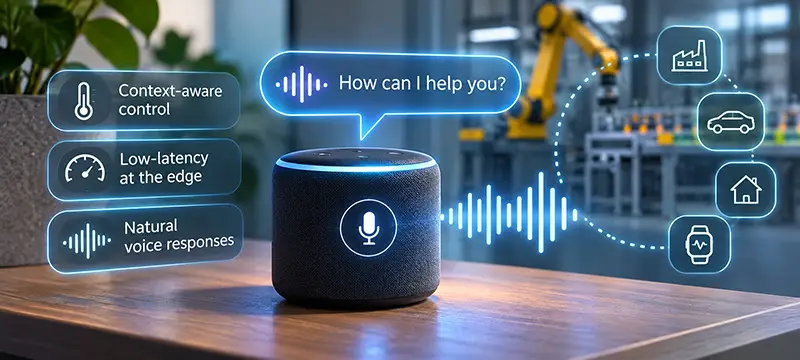
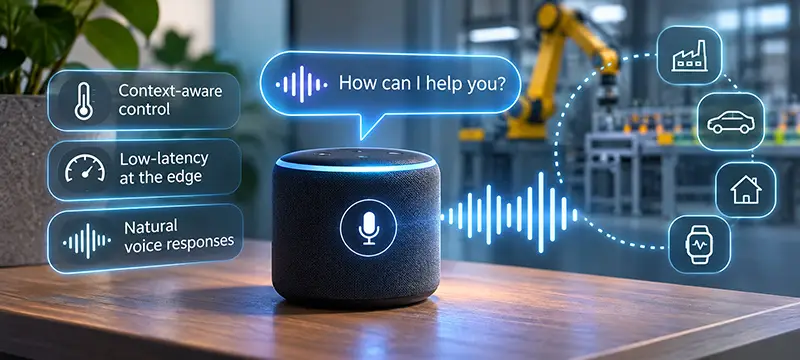
A useful embedded voice interface has to do more than recognize words. It must interpret a request against the device’s current state, respond quickly enough to feel conversational, and remain dependable when connectivity or operating conditions are poor. Those demands shape decisions about edge processing, speech generation, privacy and the actions a system is allowed to take.
ElevenLabs offers an AI personal assistant platform for developers adding spoken interaction to products and services. Its tools are intended to support conversational exchanges in which users speak naturally and receive spoken responses. For engineering teams, the central design question is how to connect that interaction to the device and its operating context.
Use device state to interpret what users mean
A command can be ambiguous when considered on its own. “Make it warmer,” for instance, could prompt different thermostat behavior depending on the current temperature, operating mode and occupancy status. A context-aware assistant needs access to relevant device settings and information about user intent before it can choose an appropriate response.
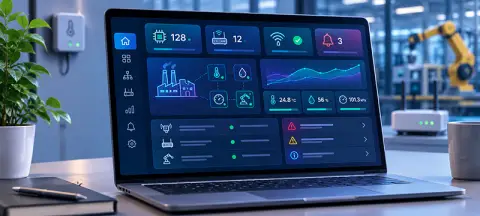
The same principle applies in industrial environments. A worker wearing a connected headset might ask for a machine’s operating temperature or request a maintenance checklist. If the assistant can draw on sensor readings and technical documentation available to the connected system, it can return information without requiring the worker to leave the equipment and consult a separate terminal.
That connection between speech and system data is where much of the practical value lies. A voice interface that merely recognizes a command may still leave users to find and interpret the information themselves. An assistant that can combine the request with device status and relevant documentation can make hands free access more useful, provided its answers reflect current, reliable information.
Place processing according to latency and device limits
Conversation makes delay conspicuous. A long pause between a spoken request and the reply can make even accurate recognition feel awkward. Edge computing can reduce that delay by handling some tasks on the device, close to where audio and sensor data are generated.
Wake word detection, background noise reduction and basic command recognition are examples of work that can run locally. Keeping these operations on the device can also reduce the amount of data sent over a network. More demanding functions, such as advanced language processing or generating expressive speech, may need additional computing resources, including cloud services.
There is no single split that fits every product. Developers have to weigh local processing against network dependence, processing capacity and power use. A wearable assistant may have tighter compute and battery limits than a home hub that stays connected and powered. A design that performs well on a stationary device may therefore need a different allocation of tasks when adapted for a battery operated product.
Make spoken output clear and consistent
Speech recognition is only half of the interaction. If a device responds with unclear pronunciation, awkward pauses or a flat, stilted voice, users may struggle to understand its answer or follow its directions. Text to speech systems can generate more natural sounding responses, and ElevenLabs offers text to speech tools as well as ElevenAgents, a conversational agent platform.
Clear audio can support tasks where attention is occupied elsewhere. A kitchen device might speak cooking instructions while someone prepares food; a vehicle assistant might provide navigation information while the driver keeps their eyes on the road. In both cases, the response needs to be understandable at the moment it is heard.
ElevenLabs says its agents support more than 90 languages and can switch languages during a conversation. That could help manufacturers serving users across different language markets. Voice cloning is another option for products seeking a particular voice, but it requires express permission from the voice’s source.
Build privacy and safeguards into the interaction
Contextual assistants may handle household schedules, location information and details about how a connected device is used. Developers should limit the personal data needed for each action and set clear rules for how data is stored and who can access it. Processing information locally where practical can limit what leaves the device, but local operation still calls for secure updates, authentication and encryption.
The consequences of misunderstanding also depend on the application. A delayed lighting command may be a minor annoyance; an incorrectly understood instruction for industrial equipment could have more serious consequences. Important actions can require confirmation, while established manual controls provide another way to operate equipment if voice interaction fails.
Test against real operating conditions
Development should start with a defined use case and the commands users are most likely to make. That gives teams a concrete basis for evaluating hardware and measuring performance. Tests should account for conditions the device will actually face, including noisy environments and unreliable network connections.
Battery use, response latency, speech recognition accuracy and spoken audio quality all need evaluation. A quiet laboratory can hide problems that emerge on a factory floor or inside a moving vehicle. The practical test is whether the complete interaction remains understandable and dependable under the conditions in which people will use it.
For embedded voice systems, the strongest design choices follow from the application: which context the assistant needs, which work the hardware can handle locally, and which actions warrant confirmation or a manual fallback. Measuring those choices in realistic conditions is what turns a voice feature into a usable device interface.