Smart Home Households in Europe and North America Set to Reach 200.7 Million by 2030
- IoT.Business.News
- 525 reads
Berg Insight forecasts 200.7 million connected households by 2030, with growth hinging on integration, services and reliable device compatibility.
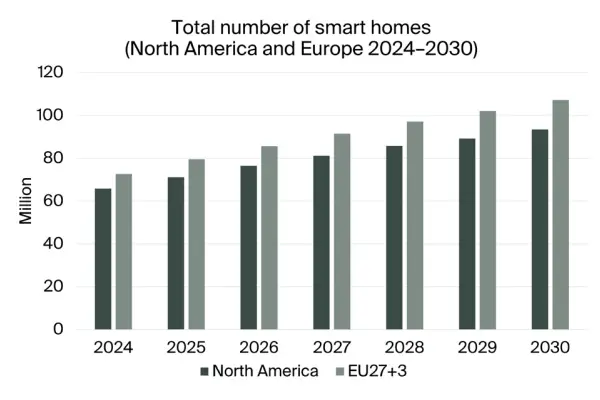
Connecting another 50 million households is only part of the smart home market’s next phase. The harder engineering and product challenge is making a growing mix of devices work together reliably, while giving households a clear reason to use more than one connected system. Berg Insight forecasts that connected homes in Europe and North America will rise from 150.6 million at the end of 2025 to 200.7 million by 2030.
Those household totals count homes with at least one smart home system. They don’t count every system inside each home, a distinction that changes how the market looks to device makers and platform providers. By the end of 2025, the two regions had an estimated 567.8 million installed systems—many more than the number of connected households.
Europe has more connected homes; North America has higher penetration
North America had 71.1 million connected households at the end of 2025, equal to 47.2 percent of households in the region. Berg Insight projects that total will reach 93.5 million by 2030, a compound annual growth rate (CAGR) of 5.6 percent.
Europe, defined in the research as the EU27+3 countries, had 79.5 million connected households in 2025. That larger count represented a lower share of households: 33.3 percent. Berg Insight expects Europe’s installed base to grow at a 6.2 percent CAGR, reaching 107.2 million homes by 2030.
The different adoption patterns reflect distinct routes into connected-home products. In North America, interactive home security services have helped introduce households to connected functions. ADT, Vivint, SimpliSafe, Comcast and Telus are among the companies combining monitoring services with home connectivity.
European adoption has a stronger presence of traditional home automation platforms and do-it-yourself products. Shelly, eQ-3, Somfy, Loxone and Verisure are among the providers named in this market. For manufacturers, the regional split points to different routes to customers, even as the need to link devices across categories is shared.
More systems than households
A connected household may have several separate smart home products or platforms, each counted as a system. North America had 314.6 million systems in use at the end of 2025: 243.7 million single-purpose solutions and 70.9 million multifunction or whole-home systems. Europe had 253.2 million, comprising 202.2 million point solutions and 51.0 million whole-home systems.
That spread between homes and systems is a sign of both adoption and fragmentation. Many households already have connected products, but those products may operate in separate applications or ecosystems. Providers can pursue growth by adding new households, and by making existing installations easier to coordinate. The latter depends on practical compatibility: a device that connects to a network may still fail to fit smoothly into a household’s wider setup.
Revenue growth outpaces household growth
Berg Insight estimates North American smart home revenues at US$57.4 billion (€50.8 billion) in 2025, rising to US$88.0 billion (€77.9 billion) by 2030. The forecast represents an 8.9 percent CAGR. In Europe, revenue is projected to increase from €44.5 billion to €75.9 billion over the same period, a CAGR of 11.3 percent.
Across both regions, annual revenue from home automation system shipments and service fees is forecast to reach €153.7 billion in 2030, up from €85.6 billion in 2025. Revenue growth faster than household growth suggests that the market’s value will increasingly depend on what connected products and services do after installation, as well as on the number of homes they reach.
Compatibility is a product requirement
Wi-Fi, Bluetooth, Zigbee, Z-Wave and Thread coexist across the smart home ecosystem, alongside different manufacturers’ devices and software platforms. Matter is one interoperability initiative intended to simplify connections between products from different vendors. Berg Insight also identifies embedded hub functions and artificial intelligence as developments to watch through 2030.
For device makers and system integrators, supporting a radio standard is only one piece of the work. Customers may expect security, heating, lighting and other equipment to act as parts of one home environment. That raises product questions about compatibility, the life of software support and the ability to connect with established platforms. A device that works well in isolation can still disappoint if it cannot participate in the routines or controls a household already uses.
AI could coordinate functions across connected devices, but that depends on reliable data access and consistent communication between products from different manufacturers. Energy efficiency and consumer trust also feature among the factors Berg Insight says will influence adoption, along with product discontinuations. Discontinued products can leave customers weighing the long-term usefulness of an ecosystem; compatibility and ongoing support therefore matter alongside the initial feature list.
Security, climate control and service robotics stand out because people can readily understand their intended benefits. Connected monitoring can address household security needs, while smart thermostats and energy management tools can help households manage energy use and costs. The next measure of progress will be how dependably these functions work together in daily use. With hundreds of millions of systems already installed, integration may shape the experience of the market’s next wave as much as adding new devices does.