IoT Gateway Revenue Forecast to Reach $2.89 Billion by 2030 as Industrial and Enterprise Uses Expand
- Satyajit Sinha
- 679 reads
Industrial and enterprise gateway revenue is forecast to reach $2.89 billion by 2030, driven by legacy equipment integration, energy sites and changing connectivity needs.
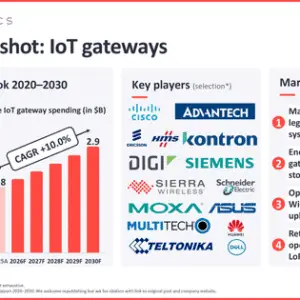
Industrial and enterprise IoT gateway hardware revenue is forecast to grow from $1.79 billion in 2025 to $2.89 billion in 2030, a 10.0% compound annual growth rate. Revenue for 2026 is estimated at $2.0 billion. The forecast, from IoT Analytics’ November 2026 IoT Gateway Market Report 2026–2030, tracks wholesale hardware revenue. Its projections point to an expanding role for gateways at sites connecting existing equipment, distributed energy assets and networks with demanding uplink requirements.
The figures cover finished hardware that gathers data from field devices and passes it to an upstream system, often across different protocols or networks. The market includes industrial equipment and enterprise settings such as retail stores and commercial buildings. Pure routers, switches, access points, standalone protocol converters, vehicle telematics, consumer gateways, software and services are outside the definition.
Industrial devices bring more revenue per gateway
The market splits along a useful distinction: enterprise is expected to add more units, while industrial applications contribute more revenue. Between 2025 and 2030, enterprise is forecast to account for 57.9% of additional units and 39.4% of incremental revenue. Industrial applications make up the remaining 60.6% of revenue growth and are projected to retain 62.4% of total market revenue in 2030.
The difference reflects pricing as well as volume. Industrial gateways generally have higher average selling prices because they may need industrial interfaces, rugged construction and local processing. For buyers, the unit count alone therefore won’t show where the market’s revenue is concentrated.
Gateways connect old equipment and distributed assets
A gateway can serve many field devices, so adding a sensor doesn’t automatically mean adding another gateway. Hardware demand tends to follow the need for a new site or network connection, additional radio coverage, or more capacity and reliability than an existing device can provide.
That makes brownfield integration a practical source of demand. Older meters and programmable logic controllers (PLCs) may communicate over field networks that a newer monitoring system can’t read directly. At Limagrain Ingredients’ plant in the Netherlands, HMS Networks’ Ewon Flexy collected data from existing energy meters and combined it with PLC production data through i4connected. Limagrain reused almost all its meters and cabling. The gateway served as an integration point while the plant kept most of its installed equipment in place.
Energy storage sites create a different integration need: gathering data from equipment distributed across storage containers. In a US battery energy storage project, Advantech’s ECU-150 gateway collected information from controllers inside each container and passed it to an energy-management computer. Depending on the system architecture, each additional container can create another gateway connection point. Across all utility applications—not energy storage alone—the forecast adds about $236 million in gateway revenue between 2025 and 2030.
5G and Wi-Fi 7 target demanding links
Cellular gateways can provide backhaul where fixed infrastructure is unavailable or where a site needs a managed connection. For remote enterprise locations such as temporary construction sites, Advantech describes using its ICR-1745 to carry video from multiple high-definition cameras. In a utility application, German consulting firm Korero GmbH selected Teltonika Networks’ TRB500 to connect substation controllers over a standalone 5G network using network slicing.
These applications call for more than routine, low-rate sensor connectivity. The forecast projects 5G’s share of cellular gateway shipments rising from 6.9% in 2025 to 42.7% in 2030. That shift makes the mix of network requirements as relevant as the overall shipment total.
Wi-Fi 7 addresses local uplinks facing congestion. Its Multi-Link Operation can improve performance on compatible equipment by using multiple links. Field trials by the Wireless Broadband Alliance found better uplink performance under interference. Those trials involved access points and clients, rather than gateway shipments; the market projection separately estimates Wi-Fi 7 will grow from 3.4% to 33.8% of Wi-Fi gateway shipments between 2025 and 2030.
LoRaWAN coverage follows buildings and sites
Low-power LoRaWAN sensors can share a gateway, but coverage needs still create demand as deployments spread across buildings or encounter obstructed areas. In a Migros supermarket pilot, one gateway served 70–100 refrigeration sensors. At Lancaster Serviced Apartments in Vietnam, WNE Solutions used four gateways to cover approximately 315 water and electricity meters across 20 floors.
These examples show why gateway counts don’t rise one-for-one with sensor counts: a single device can aggregate many readings, while each new site or coverage zone may need another connection point. LoRaWAN is forecast to account for 11.2% of additional gateway shipments from 2025 to 2030 but just 4.2% of incremental revenue, reflecting its lower average selling price.
Gateway and edge computing functions converge
Some gateway-class devices now combine connectivity with local computing and artificial intelligence capabilities. Advantech’s UNO-258, for example, pairs industrial interfaces with AI acceleration. Support for containerized applications can also let compatible gateways run multiple workloads on shared hardware.
This convergence could reduce the need for separate gateways and edge computers in some installations, while raising the computing demands placed on each device. Dedicated gateways are still likely to suit cost-sensitive monitoring and applications that require isolation or deterministic control. As product capabilities overlap, the boundary between IoT gateways and industrial PCs may become less distinct.
The market figures provide a view across 2020–2030, including historical data for 2020–2025 and forecasts for 2026–2030. The accompanying tracker covers shipments, average selling prices and hardware revenue by company, gateway type, connectivity, region and industry vertical. For engineering teams, the central takeaway is that deployment conditions—existing equipment, site layout, coverage and uplink requirements—shape gateway needs more directly than the number of connected devices alone.