Reshoring Creates Manufacturing Options, but Suppliers May Pay to Keep Capacity Ready
- Michael Petch
- 408 reads
Reshoring can qualify domestic suppliers without shifting recurring orders. The economics depend on whether customers pay for reserved capacity and production readiness.

Reshoring can expand the pool of qualified domestic manufacturers without bringing a matching volume of orders with it. That gap matters for additive manufacturing suppliers: customers gain the option to move production, while service bureaus may have to buy equipment, qualify processes and reserve capacity before knowing whether the work will arrive.

Announced jobs do not equal confirmed production
The Reshoring Initiative’s 2025 Annual Report, published in October 2026, counted 247,063 manufacturing jobs announced through reshoring and foreign investment. It attributed 152,734 to reshoring and 94,329 to foreign investment. Yet of 64 conditional announcements identified for 2025, only 14 had become confirmed projects, fully or partly, by the report’s publication. The others may still proceed; manufacturing projects take time to develop. But an announcement, supplier search or process qualification can precede a firm order by a long interval.
For a contract manufacturer, qualification can still be commercially useful: it gives a customer a domestic source it can turn to if offshore supply becomes unattractive. The open question is who funds the work needed to make that source ready. If the customer can hold the option without committing orders, the supplier may carry the costs of readiness and the risk of unused capacity.
China sourcing shifts do not show a broad return
Trade figures point to a more complicated pattern than a simple return of manufacturing to the United States. Kearney’s 2026 Reshoring Index, released in April, moved from −115 to −91 but remained negative under its methodology, indicating continued net offshoring. Imports of manufactured goods from China fell by $135 billion during 2025. Imports from the other 13 low-cost Asian countries and regions in the analysis rose by $193 billion.
Companies can reduce reliance on China by shifting orders to other Asian suppliers or Mexico, or by spreading work across multiple offshore sources. Those choices can improve supply options without moving production to the United States.
Capacity data also counsel against assuming a broad shortage. The Federal Reserve’s September 2026 figure for U.S. manufacturing capacity utilisation was 75.9%, against a long-run average of 78.2%. That aggregate measure does not rule out bottlenecks: spare capacity in one process or region cannot automatically meet a need for a qualified component, skilled operators, materials or inspection. Still, the figure alone does not establish that reshoring will require a large increase in industrial 3D printer installations.
Manufacturing groups are adding capabilities around printing
Consolidation among manufacturing service providers is continuing even as the reshoring picture remains mixed. In October 2026, CORE Industrial Partners said its portfolio company Fathom Digital Manufacturing had acquired TCS Industries, TCS Electronics and Precision Grinding & Manufacturing. The additions broaden Fathom’s capabilities in precision machining, electronics manufacturing, complex assemblies and specialised finishing, including work for aerospace customers. Fathom reported a network of 10 facilities, approximately 700 employees and more than 25 manufacturing services.
The acquisition points to a strategy that reaches beyond adding printers. A supplier that can take a customer from design and prototyping through qualified production may hold more of the relationship and more of the manufacturing work. Fathom’s corporate history also puts growth in perspective: it listed on the New York Stock Exchange after a special purpose acquisition company transaction in December 2021, then CORE completed a take-private transaction in May 2024. The company spent less than three years listed. Corporate expansion and attractive returns are separate measures.
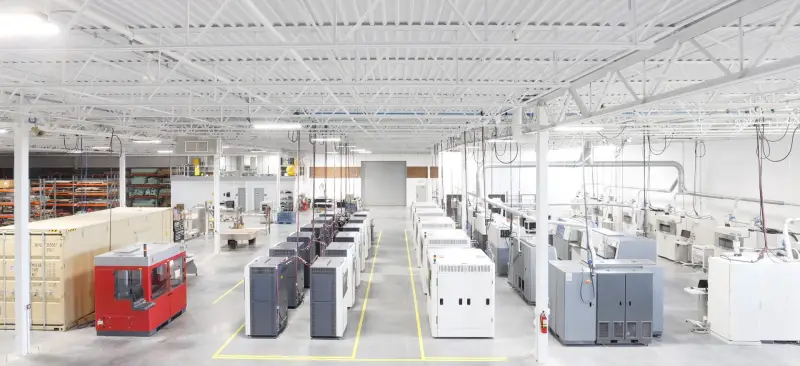
ADDMAN, backed by American Industrial Partners, acquired Forecast 3D in January. The purchase added polymer powder-bed capacity, including selective laser sintering (SLS) and Multi Jet Fusion (MJF), as well as digital quoting infrastructure. ADDMAN said its additive manufacturing fleet exceeded 160 systems after the transaction.
The potential value lies in keeping a customer as its production needs change. A project could begin with an additive prototype, move into short runs using SLS or MJF, then shift to injection moulding as volume grows. If one supplier can serve those stages, it may keep work that would otherwise move to a different provider. That opportunity depends on winning the work and delivering it profitably; printer count by itself says little about either.
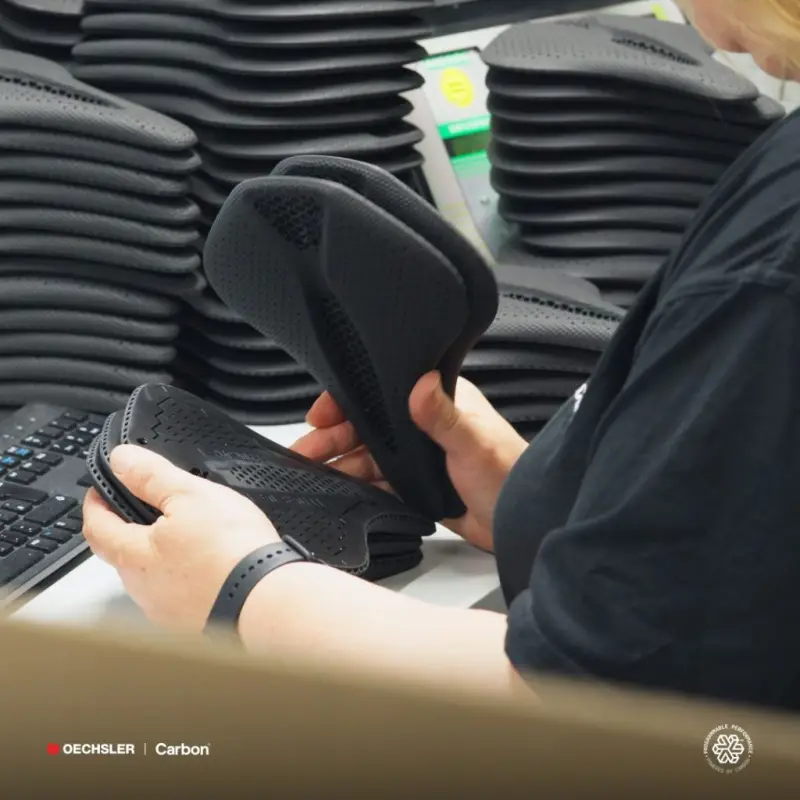
SyBridge Technologies offers another example of additive capacity aimed at repeat production. In April 2025, the company reported producing nearly two million parts using Carbon’s Digital Light Synthesis technology.
Digital procurement is growing faster than every process
Protolabs reported second-quarter 2026 revenue of $149.3 million, up 10.6% year on year. CNC machining revenue rose 13.6% to $70.4 million, and injection moulding revenue increased 13.1% to $53.6 million. Its 3D printing revenue moved the other way, falling 2.6% from $21.2 million to $20.7 million. That is one quarter at one company, not a sector forecast, but it shows that growth in digitally procured manufacturing need not translate into growth for additive work.
Xometry reported second-quarter revenue of $229 million in August, an increase of 41%. Marketplace revenue reached $215 million, up 45%, and active buyers increased 20% to 89,557. The company also reported adjusted EBITDA of $14.1 million and a GAAP net loss of $5.3 million.
These results suggest that customers are spending more through convenient manufacturing procurement channels, while demand remains uneven across processes. A marketplace that connects buyers to multiple suppliers may be well placed to sell access to flexible capacity. The suppliers providing that capacity still need a way to recover its cost.
Readiness is an option with a cost
The economics resemble the real-options framework described by Avinash Dixit and Robert Pindyck in their 1994 book Investment Under Uncertainty, and by Ben Bernanke in his 1983 paper, “Irreversibility, Uncertainty, and Cyclical Investment.” When a decision requires substantial, hard-to-recover spending, uncertainty can make it valuable to wait for more information before committing.
Consider an industrial OEM buying components overseas while weighing tariffs, delivery interruptions and geopolitical risk. Building a domestic factory would require substantial capital. Qualifying a domestic contract manufacturer offers another route: the OEM can keep buying offshore while retaining a supplier it could use if conditions change. Additive manufacturing can suit some of this work because it can produce parts without conventional tooling commitments, though process suitability and customer qualification still determine what can actually move.
The customer gets flexibility. The supplier may have to purchase equipment, employ operators, maintain certifications, complete qualification work and hold production capacity available. If the customer never switches, the supplier can be left with idle equipment and unrecovered costs. The customer’s option to delay factory spending is backed by the supplier’s commitment to be ready.
Contracts can allocate the readiness cost
There are commercial structures that could give both sides a clearer bargain. A customer might contribute to qualification expenses, commit to minimum volumes or pay for guaranteed capacity. In exchange, the supplier could define the production readiness and activation timetable it will provide. These are potential contract terms; no documented additive manufacturing case of an OEM paying for standby capacity was identified in the material behind these figures. Whether customers will pay for that flexibility remains an open question.
For manufacturing groups assembled through acquisitions, a broader network has value only when its sites and processes can serve real customer needs. A part qualified at one facility cannot necessarily move to another machine or site without customer approval, documentation and process validation. Capability lists do not make production interchangeable. The commercial test is whether the network can deploy its capacity and retain work without adding costs faster than revenue.
Independent print farm owners face the same discipline before buying another industrial printer. They need to weigh committed repeat work, the ability to subcontract overflow, the range of customers a machine can serve and the cost of exiting if a programme disappears. Staging purchases against repeat orders can limit exposure. Early investment can still make sense when qualification takes a long time or a specific capability is demonstrably scarce.
Track recurring parts and paid capacity
National announcements and installed machine counts offer a weak measure of additive manufacturing’s reshoring gains. More useful evidence would show how many part numbers have moved from offshore supply into recurring domestic orders; how revenue divides between prototypes, qualification and repeat production; and whether customers fund reserved capacity or leave suppliers to carry it. For manufacturing groups, the test is whether acquired facilities improve organic growth, utilisation and cash returns after capital expenditure.
Reshoring could create substantial work for additive manufacturing where part complexity, short runs, tooling costs and qualification requirements suit the process. It could also produce more domestic suppliers qualified to make parts, without a corresponding shift in production volume. OEMs would gain a more flexible supply chain, while manufacturers could end up paying for capacity that serves as insurance the customer never uses.
The companies best positioned to benefit will be those that retain customers as processes change and match capacity spending to work they can actually secure. Reshoring is creating demand for domestic manufacturing options; the unresolved commercial question is whether customers will pay the suppliers who keep those options available.


