Rapid Fusion Builds Large-Format 3D Printing Around Tooling and Machining
- Michael Petch
- 795 reads
Rapid Fusion pairs large-format printing with CNC machining, using thermal and scan data to help customers produce accurate industrial tooling.

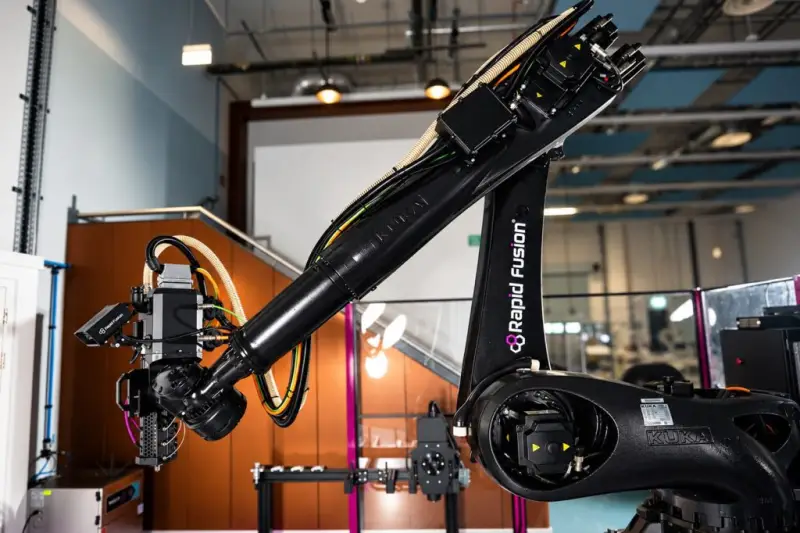
A large-format printer earns its place on a factory floor when it can produce a tool that fits the job, reaches its working dimensions and arrives sooner than a conventional order. Rapid Fusion is building its business around that gap between printing a large shape and delivering a usable tool. Its approach combines robotic deposition, thermal analysis and CNC machining, with the company taking on demanding applications to improve the software and systems it supplies.
Co-founder Jake Hand describes a site acceptance test in which a customer printed a tool that would normally have cost £50,000 to buy in machined aluminium. The printed version cost £5,000 in time and materials, according to Hand, and replaced the planned purchase. The customer began recovering the machine’s cost during the test.
Lead time mattered as much as the price. Hand says aluminium billet can take eight weeks to arrive, while a typical machined tool order takes 12 to 16 weeks. That delay can leave engineers working with a design that no longer suits the task by the time the tool arrives. Bringing production in-house gives the people using a tool more influence over when it is made and revised. The high-value, difficult job may justify a machine, but routine tooling can help keep it earning.
Choosing the factory floor
Rapid Fusion’s roots are in selling other companies’ large-format filament printers through Evo 3D. Hand saw customers with build spaces of about one metre in each direction joining printed sections to make the shapes they needed. The work after printing suggested an opportunity: the value lay not only in making a large part, but in turning it into functional tooling.
Hand initially expected customers to pay somewhat more for a better machine. He found two clearer markets instead: buyers seeking an affordable printer for occasional work, and industrial users with enough valuable production work to justify a premium system. The middle ground proved hard to sell. Rapid Fusion chose the factory floor, then had to decide which applications it could serve well. Furniture, decorative panels and aerospace tooling all suit large machines, but each demands different expertise.

Predicting shape and finding the part
For tooling used at elevated temperatures, the finished dimensions depend on more than the CAD model. Printed material can expand differently along and across the deposition lines. As a result, tools made from the same material to the same drawing can change shape differently when the printer follows different paths.
Rapid Fusion’s engineers tackle difficult jobs in-house and use the experience to update customer software and firmware. Its thermal analysis software uses the deposition path, material and intended operating temperature to predict how a tool will change shape. That prediction informs both the print and the later milling operation. The relevant dimension is the working surface at its operating temperature, rather than simply the shape measured as it leaves the printer.
Large prints also pose a positioning problem when they move to machining. For a six-metre part, an operator needs to know where the printed object sits on the bed before milling. Rapid Fusion’s scanning system combines successive images into a point cloud, then aligns the CAD model with the measured part. Hand’s example is a print with eight millimetres of finishing stock: the mill can locate the intended surface from the scan, without an operator first touching off multiple reference points with the milling head.
At Kingston University’s Roehampton Vale campus, a £450,000 Zeus robotic cell combines printing and CNC milling. Students, researchers and industrial partners can use both processes in one system.
Installations, training and new applications
Hand puts Rapid Fusion’s installed base at around 43 systems, with the largest concentration in the UK, followed by Central Europe. When he spoke, a team was installing a machine in Honolulu after roughly a year of building recognition in the US. The company looks for resellers that already have service engineers and electricians. Rapid Fusion staff lead early installations and train local teams to take on later ones.
Hand estimates that a robot can require “three to six months of heavy learning and R&D” before operators understand its capabilities. He says most business cases the company quotes put payback within two years. As customers gain experience, some ask for help with the manual handling, sanding and machining that still follow printing. That points to a practical limit in the current process: a printer can shorten tool production while leaving substantial finishing work.
Shipbuilders are another developing customer group. Hand counted three or four deals during the preceding month across marine applications and uncrewed surface vessels. A printed hull still needs considerable work before it can enter commercial service. Rapid Fusion is pursuing a route through Lloyd’s Register; Hand also says the company won an Innovate UK bid for a vessel project. A separate bid for a three-year aerospace tooling project was awaiting a decision in December.
The company has packaged its Medusa system in a container, adapting a machine that previously relied on an external air supply. The container version carries its own services, makes room for an operator and runs from a single power connection. Hand says parts of the UK Ministry of Defence have trialled the system, with a shipboard trial planned. He also sees a possible oil and gas application if the system can be adapted to print PEEK for pipework.
For prospective buyers, Hand’s advice is to ask what a machine builder has already made for the same kind of work. A large exhibition print can show that a machine has reach; the harder factory question is whether the process can predict the part’s dimensions after heating and machining. Rapid Fusion’s pitch depends on answering that question with application experience, scan data and software tailored to the tool’s actual use.