UK Additive Manufacturing: Turning Research into Repeat Production
- Michael Petch
- 894 reads
UK firms have strong AM research and engineering, but repeat orders, customer qualification and production experience remain the tests of commercial growth.
Britain’s additive manufacturing challenge is not a shortage of research or inventions. It is getting customers to commit to repeat production, building the installed base that develops skilled operators, and financing the work between a successful prototype and a dependable product business. Those steps determine where parts are made and where manufacturing experience accumulates.
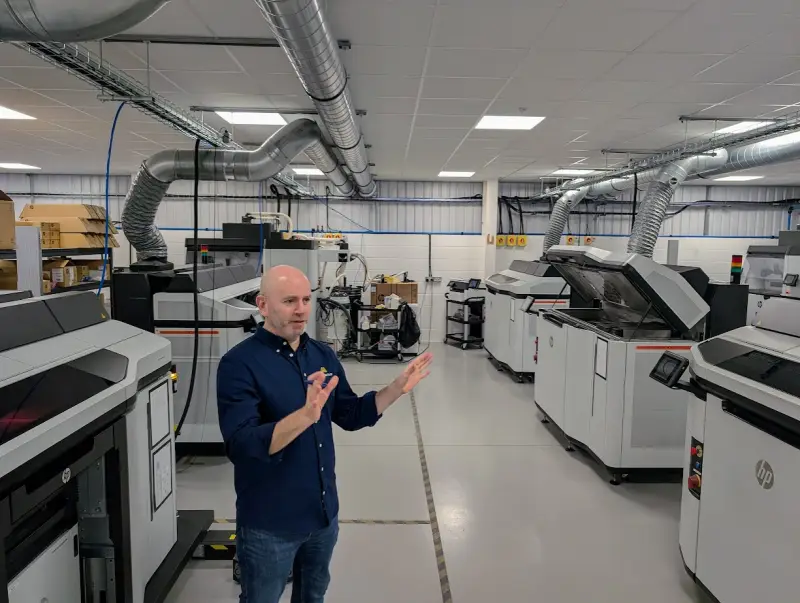
The issue is visible in Portsmouth, where AMufacture makes production parts on industrial 3D printers. The city’s manufacturing history offers a useful comparison. In 1803, machines designed by Marc Isambard Brunel and built by Henry Maudslay began making wooden pulley blocks at Portsmouth Dockyard. The Royal Navy had a clear requirement: its ships used blocks in known sizes and quantities. One ship, HMS Victory, needed more than a thousand. By 1808, the dockyard’s 45 machines produced 130,000 blocks.
The machinery mattered, but so did the buyer’s ability to specify the work and assess the first installations before ordering more. British additive manufacturing companies face a similar test today. A working machine or promising process is a start; a customer willing to install it, qualify parts and place another order is stronger evidence of a business.
Research strength does not show where parts are made
Will Richardson, chief executive of Wayland Additive, points to Britain’s strengths in metallurgy and materials science at Sheffield, Birmingham, Cambridge and Oxford, alongside the cross-institution work of the Henry Royce Institute. Wayland itself grew from a team with electron-beam experience in the semiconductor industry. In October, its Huddersfield facility shipped a Calibur3 metal additive manufacturing system to the University of Innsbruck. Researchers there plan to study difficult-to-process materials, including those intended for high temperatures.
The shipment demonstrates British capability in designing and building industrial equipment. It also shows why invention counts do not tell the whole story: some of the knowledge generated by operating the machine will accumulate at its overseas destination.
The European Patent Office counted 1,925 international patent families in additive manufacturing originating in the UK between 2001 and 2020, close to France’s 1,938. Additive Manufacturing UK estimated the UK market at between £515m and £740m in 2024, or 3% to 4.3% of the global total. The range reflects differences among market estimates. Neither figure reveals what share of the resulting production takes place in Britain. Patents record efforts to protect inventions across jurisdictions; market estimates may include purchases of equipment made elsewhere.
Craig Pyser, chair of Additive Manufacturing UK and chief executive of AMufacture, considers Britain’s position respectable for an economy of its size. He also recognises the familiar concern that British engineers can invent technologies that are commercialised more successfully elsewhere. His focus is on the reasons a customer might choose to manufacture locally. Some AMufacture buyers value being able to visit the factory, trace a part’s origin and get a replacement quickly.
Several routes can turn research into a business. Researchers at Added Scientific highlighted Wayland and Alloyed. The latter began in Oxford materials research and licensed a cast nickel alloy to Hitachi Metals in 2018. It later opened component development and production facilities in Abingdon and Seattle; the Seattle operation sold its first flight parts in 2023. One research base led to businesses licensing alloys, making components in Oxfordshire and serving aerospace customers in the United States. The patent’s origin and the location of the next production order are different measures of industrial value.
Funding a working machine is only part of the job
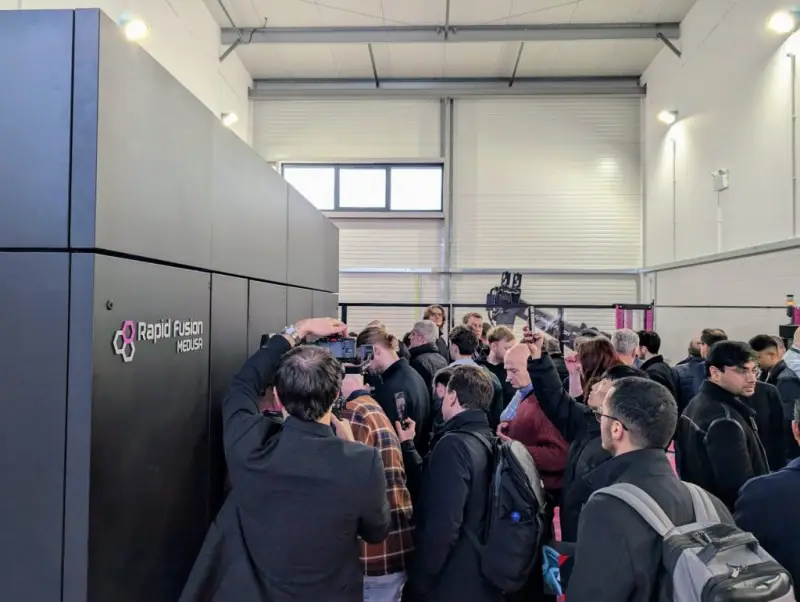
Jake Hand, co-founder of Exeter-based Rapid Fusion, has seen research funding from the company side. Rapid Fusion grew out of equipment distributor Evo 3D and now builds large-format additive manufacturing systems. Hand says the company is profitable without research and development funding. Support from Innovate UK has helped it develop technology, work with partners and share costs it could not otherwise carry alone. He credits stronger partnerships and a better understanding of assessment criteria with improving the company’s success rate.
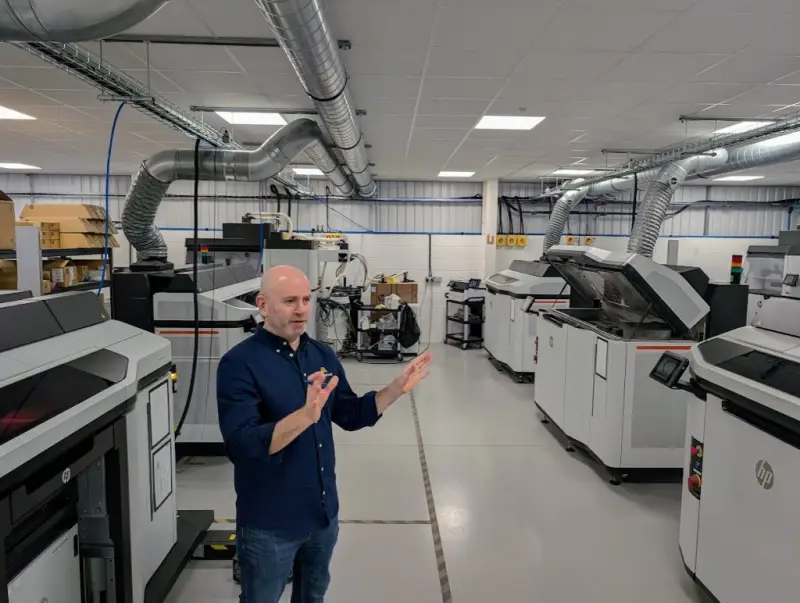
His concern is the transition after a project succeeds. “They back a project, but not a business,” he said. A grant can fund engineering work on a defined problem and leave a company with a functioning machine. A prospective customer still needs to know whether it can make a particular mould, train an operator and get support if a job stops partway through. Answering those questions for one sale can consume months of a small company’s time. Another competition focused on technical novelty may then pull the team back towards development instead of customer support and sales.
Innovate UK does have later-stage research and development funding. Its guidance allows eligible projects to include pre-commercial work such as customer validation, initial tooling and production preparation. General business costs are outside that scope. For a small manufacturer, the distinction lands in practical hiring choices: the company may need an engineer to finish development and a commercial employee to find and support customers, while having the budget for only one.
Pyser calls applications for innovation funding “excruciatingly difficult”. He would like assessors to visit businesses that pass an initial screening, since a factory visit can show whether a team and its equipment can deliver the proposed work. Hand agrees that some applications are poor, but argues that a successful delivery should count when a firm applies again. Their accounts point to a further question: among companies that complete funded development, how many sell the resulting product, how long does that take, and who becomes the customer?
A £450,000 installation at Kingston University shows how a customer relationship can form. Lesley Stigling, the university’s operations manager, said a graduate named Raghav went to work at Rapid Fusion and pushed his employer and former university to meet. The result was a Zeus robotic cell at Kingston’s Roehampton Vale campus, combining large-format printing with CNC milling. The university can use it for in-house work, offer the equipment to industrial partners and train students. Rapid Fusion, in turn, has a customer able to demonstrate the machine in use. A graduate familiar with both the equipment and the university helped identify the fit.
Spin-outs need a financing structure that can grow
John Robinson, the University of Wolverhampton’s additive manufacturing research commercialisation manager, incorporated a company in May 2017 to fund his PhD. He says he and the university filed several patent applications together in 2024. His current research includes multi-material devices designed to carry heat away from data-centre equipment. Building an investment case for the technology has taken a significant share of his professional life.
Robinson recalls that the university’s former technology transfer office sought 75% ownership of the company. In more recent discussions, he says, the university’s enterprise team considered a potential 10% stake. These were proposals, not completed transactions. Robinson’s concern was how much equity would remain for a founder once outside investors and later financing rounds were included, and whether the company could raise enough to reach its technical and commercial goals.
Data from the Royal Academy of Engineering and Dealroom suggest that university stakes in UK deep-tech hardware spin-outs have been declining. In their sample, the average non-cash stake fell from 25% in 2015–19 to 14% in 2024–25; the 2025 figures were partial. Robinson’s experience describes one set of negotiations, while the wider data point to a change in average practice.
He recalls submitting about 11 business plans over several years and having to explain the proposition again after senior staff changes. He accepts that a central university office may have to assess proposals across very different fields. Still, he asks, “But if they don’t understand the potential of what we’re explaining, why would they take it forward?” He would place more commercial expertise in research departments, where staff can understand the technical history and know the people who might use the work.

Louis Masters, founder of Hydra Manufacturing, has secured early financing for a University of Leeds spin-out developing equipment to make technical ceramics. In March, the company announced £320,000 in equity investment led by SFC Capital. Including earlier grants, it had secured about £577,000. Masters was considering a raise of around £1m or more to develop the equipment and expand the business.
He understands why investors want to see two more installations: a customer putting equipment on a factory floor provides a stronger signal than an expression of interest. An installation also lets Hydra see how the system performs against another company’s production schedule. Yet developing the equipment and winning those customers both require capital. “I’m trying to sell and I’m trying to raise, and they’re taking time away from each other,” Masters said. Germany, with its concentration of advanced ceramics manufacturers, is a natural market for Hydra. The location of early customers will help shape which applications the team develops first.
Production experience grows with the installed base
Richardson’s point about commercialisation comes down to practice: “So if you’re not actually doing the doing, then you’re not going to get good at it.” Britain has a limited installed base of industrial equipment, he says, and some markets lack large customers willing to put production work through it.
That gap affects hiring. An engineer experienced in CNC machining can learn to operate an additive system, Richardson says. Where several factories already run the equipment, a company can also recruit people who have prepared builds and learned how to keep a machine productive. With fewer installations, each firm has to provide more of that training itself.
Paul Tickle of British post-processing specialist Holdson sees a difference in recruits who have used industrial equipment during apprenticeships. At Wolverhampton, Robinson says, students arrive eager to redesign a bicycle and print parts, while the foundry training centre attracts fewer young people. Universities can inspire strong interest in design and 3D printing while still struggling to supply the skills local manufacturers need on the factory floor.
Renishaw’s Ben Deary and Ed Littlewood describe the difficulties companies encounter when they try to bring production back after years of overseas purchasing. A firm can buy a machine and hire operators, only to find that a former supplier of components or services has disappeared. Apex Additive Technologies in Wales helps companies rebuild some of that capability. A specialist can develop process parameters, make initial parts and establish that a process works; the customer can then decide whether to bring production in-house. The specialist earns revenue from development, while the buyer can assess a proven process before committing to its own equipment and staff.
That learning has a cost, and customers may have to repeat qualification work for different equipment, processes or material grades. Jason Hutt, managing director of Fastech, captures the advantage of an established process: “Casting’s approved, isn’t it?” A customer already buys castings to an agreed specification. An additively manufactured replacement may pass material tests but still need evidence tied to the specific production process and the customer’s requirements. A second buyer may ask for much of that work again. The economics differ sharply between a run of fifty parts and one of five thousand.
The £38m Airbus-led DECSAM programme is one effort to share some of that development work in civil aerospace. Renishaw, GKN Aerospace, Apex, the Manufacturing Technology Centre and other partners are involved. Planned outputs include ground and flight demonstrators and guidance on qualification. Suppliers can learn what a major customer needs while processes are being developed, but a production contract remains a separate purchasing decision. That follow-on order is what could justify adding production shifts.
Buyers need a reason to change a proven process
Jason Bowes, chief operating officer of CloudNC, offered a direct comparison at a Manufacturing Technologies Association briefing on 12 November: “It’s far, far easier to sell our technology in the U.S. than it is here.” CloudNC develops software that uses artificial intelligence to assist with CNC machine programming and tests it at its own British factory. Bowes joked about the tools the team had broken while developing its models. A machining business considering the software has a reasonable question: who has already paid for those mistakes?
Hand also finds American buyers more inclined to reinvest after a good year. Cautious purchasing managers may still understand the case for new equipment. A shop with an uncertain order book must cover the cost of its existing machines. A process promising lower part costs at full utilisation offers little comfort if the buyer expects to fill only a fraction of the available hours. A volume commitment, payment for qualification or a costly production problem can change the calculation.
Pyser estimates that 95% to 98% of AMufacture’s work is now production. The company started in marine; over the past year, he says, marine and automotive have been significant sectors. Some customers revise designs every six to eight weeks. Conventional tooling may take long enough that a drawing changes before the tooling is ready. A nearby manufacturer able to work from the revised file and supply the next batch can win repeat orders even as the product evolves.
Production customers also expect more than machines. One automotive client moving a project into production required someone with at least ten years’ experience in a particular area of delivery, Pyser says. Other buyers want systems that integrate with their own, traceability and a responsive contact if a batch fails inspection. A room full of printers does not provide those services on its own. Winning enough orders to hire experienced staff can make it easier to meet the same requirements for the next customer.
One AMufacture customer decided to move some work in-house, and the company helped get the new printer operating. “They still kept on ordering from us,” Pyser said. Two years later, the customer sold the machine back to AMufacture. Software, staffing and post-processing had made in-house production more demanding and expensive than expected. Counting firms with their own printers would suggest that the work had moved out of AMufacture. Looking at where the parts were made, the production remained in Britain, handled by a specialist able to spread operating costs across several customers.
The next test is the second customer
Additive manufacturing does not have a single maturity level. Added Scientific distinguishes established single-material production from research into devices that combine several materials in one build. Printed stainless-steel parts are commercially available. A multi-material sensor may still need basic validation to establish that it works. The first case needs a buyer prepared to specify and accept parts; the second may reasonably need research support. Treating both as if they were equally ready for production would misdirect funding and customer expectations.
For equipment makers and service providers, the practical measure is whether an installation leads to more work. Pyser’s test for Britain’s presence at Formnext is whether an overseas company looking for a European base chooses to establish it in the UK. He also points to smaller signals: whether a buyer who saw a British-built machine orders one, and whether an initial installation leads to another.
Britain has research expertise, patented inventions and companies capable of building advanced equipment. The harder work lies in funding customer validation, supporting installations, qualifying parts and training people through repeated production. More installations can create experienced staff; those staff can help make the next installation productive. Repeat orders then give manufacturers a basis for investing in capacity and development.
That cycle is the measure to watch as UK companies meet customers at Formnext. The question is not simply who has built a capable machine. It is which customer will put it to work, what parts will follow, and whether the next order arrives.