Wayland Additive Uses Charge Neutralisation to Control Metal AM Builds
- Michael Petch
- 848 reads
Wayland’s NeuBeam process keeps powder loose while controlling part temperature, opening options for crack prone alloys, fine supports and fewer post build steps.
Wayland Additive’s electron beam process changes a key metal additive manufacturing trade off: the powder around a part can stay loose while the part itself is held at a controlled temperature. That combination could help manufacturers print crack prone alloys, clear fine internal passages and reduce some support removal and heat treatment work.
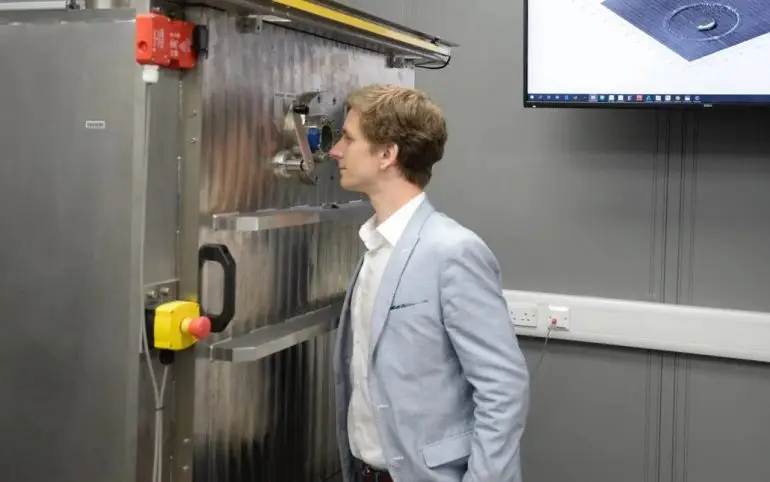
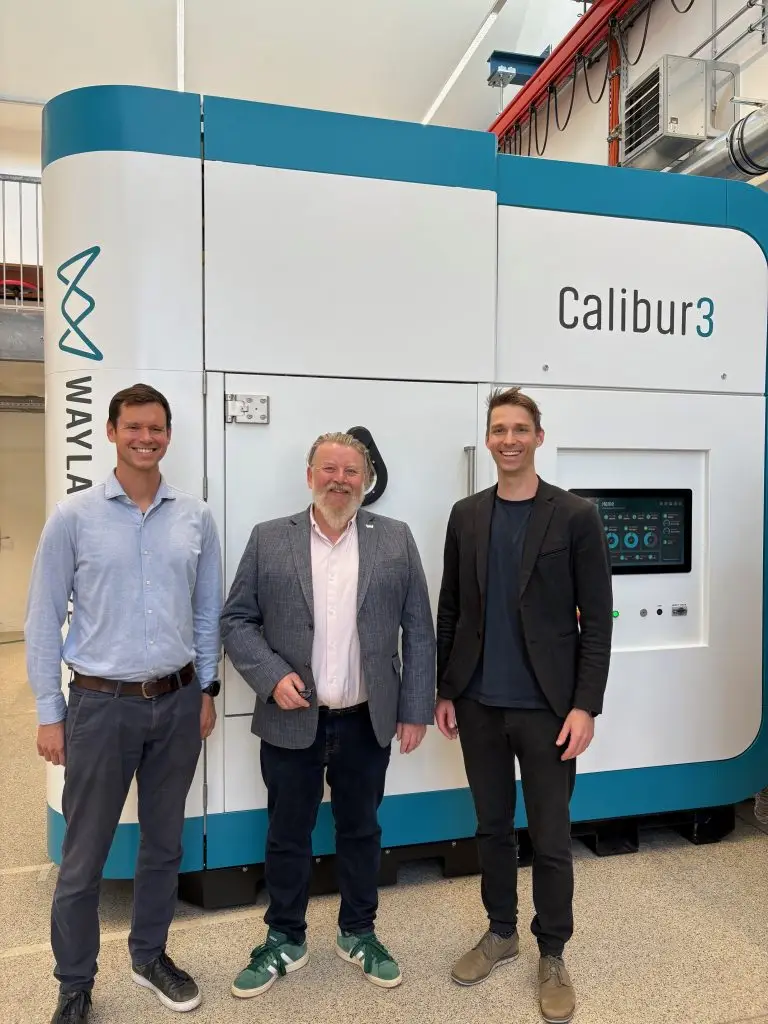
The Huddersfield machine builder developed NeuBeam for its Calibur3 electron beam powder bed fusion system. Co-founder and chief executive Will Richardson and co-founder Ian Laidler began working together on the problem in 2016. Laidler brought decades of semiconductor experience in electron beam lithography; Richardson led the project that took the idea from prototype to machine builder.
Keeping powder in place without sintering the bed
Electron beams can charge metal powder before melting it. The resulting electrostatic effects may disturb the newly spread layer, a failure mode known in the industry as a smoke event. Conventional machines counter this by heating the powder bed until particles sinter into a lightly bonded cake. The cake holds the powder steady, but it also has to be removed from the finished component.
That approach leaves operators balancing two requirements: the bed must be hot enough to bond, yet cool enough that the cake can be broken away from the part. NeuBeam uses active charge neutralisation to keep the powder from lifting, removing the need to sinter the entire bed for stability. The machine can then set the temperature of the growing component more directly.
For turbine blades, that control may matter with nickel based superalloys that are susceptible to cracking during printing. A hotter build can help manage that risk, while loose surrounding powder makes it easier to clear narrow cooling galleries. Richardson said Wayland had removed powder from channels as small as 1 mm. He identified CM247 and related high gamma-prime alloys as materials drawing interest.
Temperature control can also change support design for titanium parts. Thick sections can accumulate residual stress and distort, often requiring substantial supports to hold them to the build plate. Richardson said some jobs can instead use finer, porous supports that separate more easily at the component interface. Depending on the part, the process can also allow a thinner substrate and remove a separate stress relief step.

Other alloys may benefit from cooler builds. Richardson pointed to steels whose corrosion resistance can decline when build temperatures are too high, and higher carbon grades that may reach their required hardness as printed. The production saving depends on the customer’s specification: a post build heat treatment can be removed when the component already meets the required properties.
Choosing the jobs that suit an electron beam
Richardson sees aluminium and thin walled, lightweight parts that already print reliably as cases where laser powder bed fusion remains a natural fit. Calibur3 is aimed more at difficult builds: bulky sections prone to distortion, alloys that crack, or titanium components that would otherwise wait for casting.
Electron beam systems ask more from both the engineering team and the machine builder. Process development involves managing the part’s temperature as well as the melting beam. The hardware also has to operate under high voltage, high temperature and high vacuum. Richardson described the supply challenge plainly: “There’s no kind of supermarket for electron beam columns.” Wayland has had to develop subsystems that work together as a complete machine.
Beam speed offers another way to raise output. A single beam can move rapidly among several points and maintain multiple melt pools. Richardson described operating patterns with 16, 24 or 36 pools. Each receives only part of the beam’s time, reducing the effective power at each site while allowing work across multiple areas of a component.
Tungsten tests the thermal approach
Wayland and Fraunhofer IFAM in Dresden have made high density, crack free tungsten demonstrators on Calibur3. Richardson sees fusion energy as a potential market for the material. He argues that building larger parts can help because concentrating heat on the component reduces the area radiating heat into the machine, leaving more available power to keep the part hot. The partners’ next steps include improving productivity, trying other powders and producing more demanding geometries. Wayland has published an update on its tungsten work.
Qualification and total production work
An aerospace replacement component provided an example of the qualification effort involved. Richardson said the route to a flight proven part took less than two years and included qualifying the machine, destructive testing and non destructive testing of the material. He expects the experience to help shorten later programmes, while noting that the timeline depends on what the part does.
Richardson said early customers are now producing parts and have returned to purchase more machines, but declined to give an installed base figure. A planned US applications facility is intended to let prospective customers assess work locally, including projects whose data must remain in the country.
The equipment price alone doesn’t determine whether a metal AM process makes sense. Richardson’s comparison includes the operations that may follow printing: a vacuum furnace needs floor space, calibration, spares and an operator; substantial supports can require wire EDM or five axis machining. For a particular component, the economics may turn on whether internal passages can be cleared or supports can be removed cleanly.
Wayland plans to exhibit at Formnext in Frankfurt from 17–20 November 2026, in Hall 12, Stand B139, with a focus on titanium casting replacement, tungsten and other refractory metals, and high gamma-prime nickel superalloys. The engineering question for prospective users is whether controlling part temperature while leaving the powder loose removes enough downstream work to justify adopting a different build process.


