Added’s JetForge Lets Researchers Test Materials Across Interchangeable Printheads
- Michael Petch
- 787 reads
Added built JetForge to test unfamiliar inks across different printheads, with modular hardware for lab research and material development.

Testing an inkjet material is a machine problem as much as a chemistry problem. An ink may need a particular printhead, fluid supply and drive waveform to form consistent droplets—and those requirements can change as the material is adjusted. Added, a University of Nottingham spin-out, built JetForge to let researchers configure those parts around the material under test. It now sells the platform as well as using it for contract research.

The need is clear in a component that combines structure and electronics. A printer might use one head to deposit a light-curable polymer, another to lay down conductive paths inside the part, and a third to print wax supports. Each material must pass through a nozzle and land in the intended location, but the printhead suited to one fluid may not work for another.
Added’s founders—Richard Hague, Chris Tuck and Ricky Wildman—started the company to take on industrial projects that the University of Nottingham research group could not pursue on its usual terms. Some jobs were too small for an academic programme; others required a commercial timetable and confidentiality. Added’s early work spanned several areas, but the business has since focused on material jetting and binder jetting, including formulation work and custom equipment.
A modular platform for materials work
JetForge grew out of equipment the team needed for its own research. Hague described the original tools as “tools that we use internally that we couldn’t buy elsewhere”. They needed to run printheads from different manufacturers on one platform and change materials without rebuilding the apparatus. That called for custom driver electronics and fluid handling.
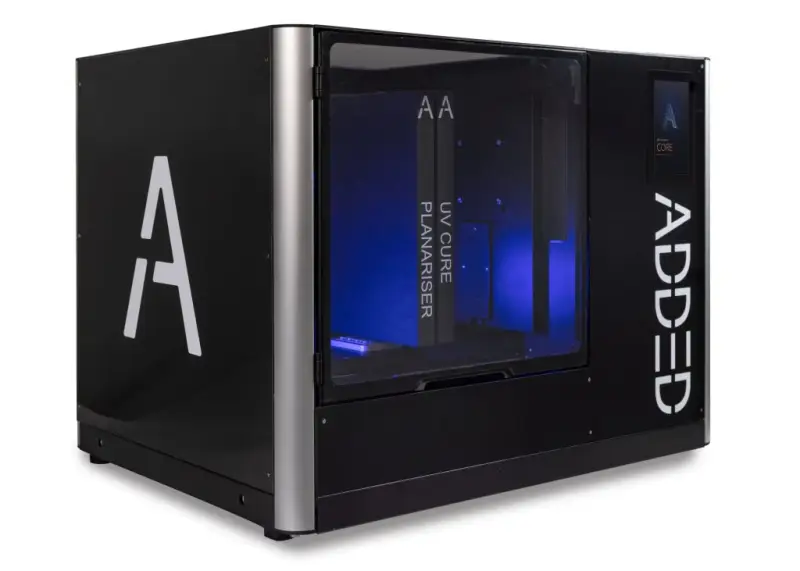
The system brings those components together in a removable module called a Blade. Each Blade contains a driver board, recirculation pump, ink supply and printhead. Researchers can swap assemblies or operate different heads alongside one another. JetForge Go has two Blade positions; JetForge Core has six. A position can also be configured for tasks such as curing or droplet inspection.
That flexibility addresses a limitation of both production oriented and development equipment. Commercial prototyping printers often pair a printhead with materials qualified by its manufacturer, which can provide confidence in reliability and printhead life while limiting trials with other inks. Some development systems offer more freedom but still tie the user to one supplier’s printhead. Hague also said equipment in his own lab could be intimidating for new users, with researchers taking months to learn it.
Contract research helped pay for JetForge’s development, and the two sides of Added’s business continue to feed each other. Hague expects research and equipment to approach an even split of the company’s activity this year. A customer might purchase a platform to investigate an ink, then ask Added to diagnose why its behaviour varies between batches.
Reliable jetting takes repeated trials
Tuck begins a new ink assessment by checking viscosity at the temperature the printhead will use. Adding solvent can make a fluid easier to jet, but it can also lower the amount of functional material in each droplet. Conductive inks bring another concern: particles may cluster, so the formulation may need to keep them dispersed. Heating can help with fluids that are too viscous at room temperature.
A single successful ejection does not establish that an ink can run consistently. Tuck said, “just because you can eject it once doesn’t mean you can eject it 10,000 times a second”. Added uses a camera to observe droplets over many thousands of firings. Solvent evaporation can shift a formulation’s behaviour during a run, while uneven particle distribution may produce erratic jetting. Researchers can then alter the drive waveform, change the fluid or try a different printhead. The aim is to find operating conditions that sustain reliable printing.
Another option is to keep the ingredients separate until they reach the build surface. In reactive jetting, different heads deposit ingredients that react after landing. Those ingredients can be fluid enough to jet even when the material they form would be too viscous to pass through a nozzle. Hague said Added had used this approach with silicones and polyurethanes. Choosing suitable heads can therefore affect which materials a process can produce.
Applications shaped by three dimensional circuits
Tuck sees bespoke electronics as a near term opportunity, especially when the circuit’s shape matters. Conventional manufacturing already produces planar circuits at high volumes and with performance that printed conductors may struggle to match. But a flat circuit must be assembled into the finished three dimensional product. Depositing a conductive path as the component is built offers another design route. Printing a sensor directly onto fabric could serve a similar purpose in wearable devices.
Hague also pointed to combinations of graphene and dielectric materials for pressure, humidity and temperature sensors. The University of Nottingham group is investigating quantum sensing. For customers considering the cost of adopting a new process, Tuck’s immediate case is a device that needs to be designed, customised and put to use quickly.
Two projects show the range of material and application questions involved. In work with Evove, Added developed materials for jetting spacers used in desalination filtration products, while Evove developed a large format printer. Tuck could not confirm whether Evove continued using that process in later work. A separate project with AstraZeneca explored printed oral dosage forms. Hague left open whether the work would lead to a change in an established pharmaceutical production line.
Investment from additive manufacturing veterans Brent Stucker and David Leigh helped Added bring JetForge to market sooner, Hague said. The founders also wanted investors with experience building, scaling and selling businesses in the industry. JetForge’s next test is practical: whether researchers outside Added can install a suitable printhead, load their material and use the system to establish repeatable process conditions.
Added plans to show JetForge Core at Formnext in Frankfurt from 17–20 November 2026, at stand F139 in Hall 12.0. JetForge Go is scheduled to appear on Ricoh’s stand, E58 in Hall 11.0.