Chinese PCB Assembly for Overseas Buyers: What to Check Before You Order
- Love PCB
- 713 reads
EBest Circuit offers no-MOQ Chinese PCB assembly with free DFM review. Here's how the purchasing split, inspection scope and delivery dates shape the real cost.
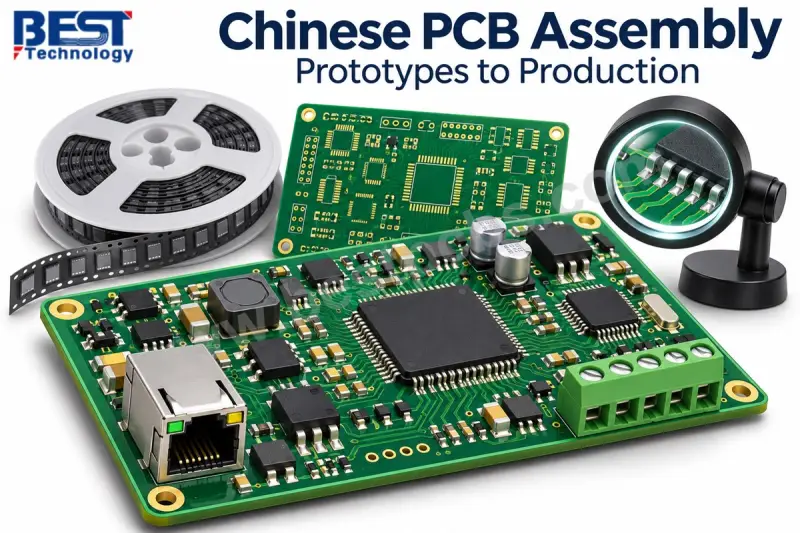
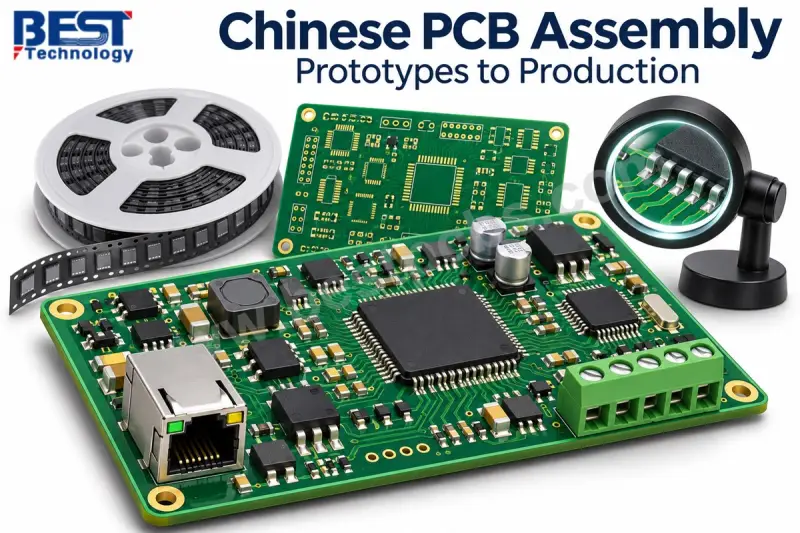
For overseas OEMs, the useful question about a Chinese assembly house isn't the price per board. It's who owns each part of the build, what gets inspected, and when the finished boards actually reach your dock. EBest Circuit describes its offer as one project covering PCB fabrication, component sourcing, SMT and through-hole assembly, and testing, with no minimum order quantity and a free DFM review. That model can simplify a first overseas build, but it only pays off if your team understands what each piece covers.
Why One Supplier for Boards and Assembly Matters
Splitting a build across a bare-board house, a component broker and an assembly line creates handoffs. Each handoff needs its own files, its own lead time and its own quality responsibility. When one supplier handles fabrication, procurement and assembly, the same engineering questions can be settled in one thread, and a stencil or footprint issue gets caught before materials are committed.
The cost picture is less simple. A repeat order with stable components spreads setup work across many assemblies. A small urgent order may spend a large share of its budget on tooling and express freight. And an allocated processor or an expensive power device costs what it costs, regardless of which country the board is assembled in. The consolidation saves coordination effort; it doesn't erase the bill of materials.
What the SMT Line Specifications Actually Mean
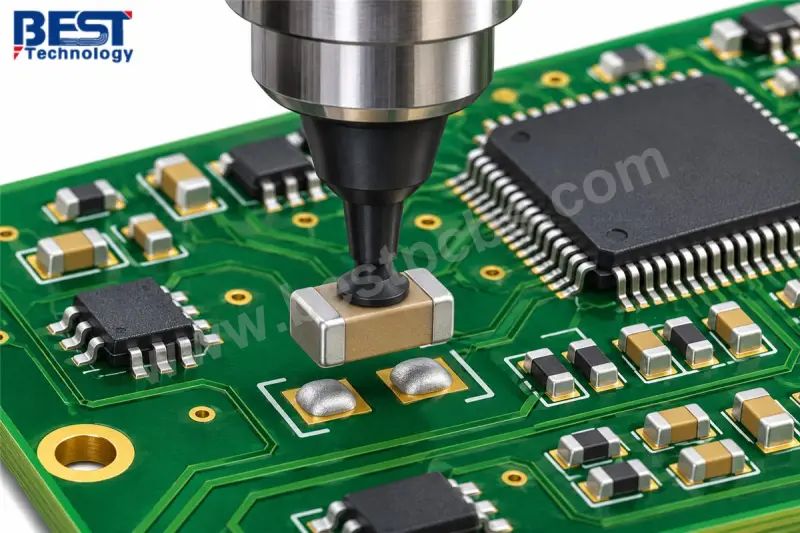
EBest Circuit states that it runs 4 SMT lines, 2 JUKI and 2 YAMAHA, supporting 01005 components and BGA pitches down to 0.25 mm. Those numbers describe the equipment's stated limits, not a guarantee for every layout. A 01005 part only works if the pad geometry, solder paste volume and stencil aperture are designed for it. A 0.25 mm pitch BGA depends on the same factors plus PCB construction and the inspection method used afterward.
The company's capability summary lists the following:
| Assembly item | Capability |
|---|---|
| SMT production lines | 4 lines: 2 JUKI and 2 YAMAHA |
| Assembly methods | SMT, THT, and mixed assembly |
| Minimum SMD component | 01005 |
| Minimum BGA pitch | 0.25 mm |
| Component supply formats | Reels, cut tape, tubes, trays, and loose parts |
| Soldering processes | Reflow and wave soldering |
| Inspection equipment | 3D SPI, AOI, and X-ray |
| Test support | Functional testing to agreed project requirements |
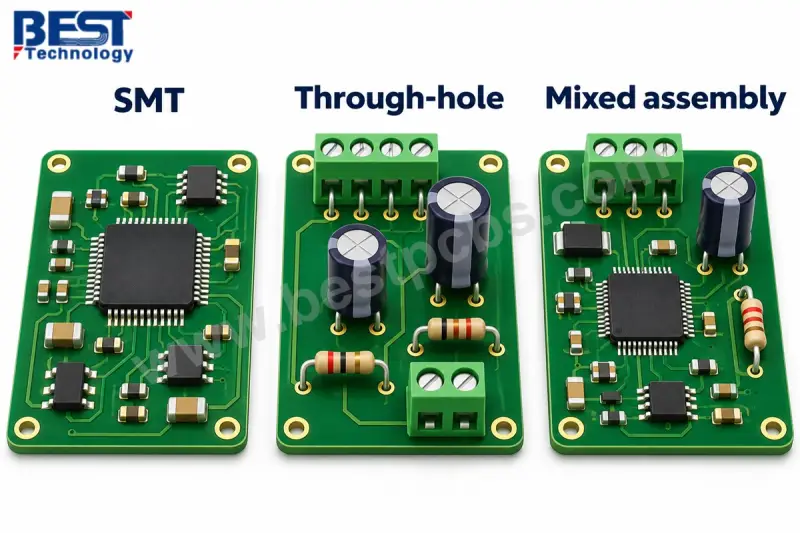
Mixed boards are where process planning gets interesting. A control board might pair a fine-pitch processor with through-hole terminal blocks. The SMT line places the small parts, then a separate through-hole operation finishes the connectors. If those two steps are planned together, you avoid cases where a connector shadows a component that needs inspection, or where hand soldering becomes the only way to finish a joint. That sequencing question belongs in the DFM discussion, not after the boards arrive.
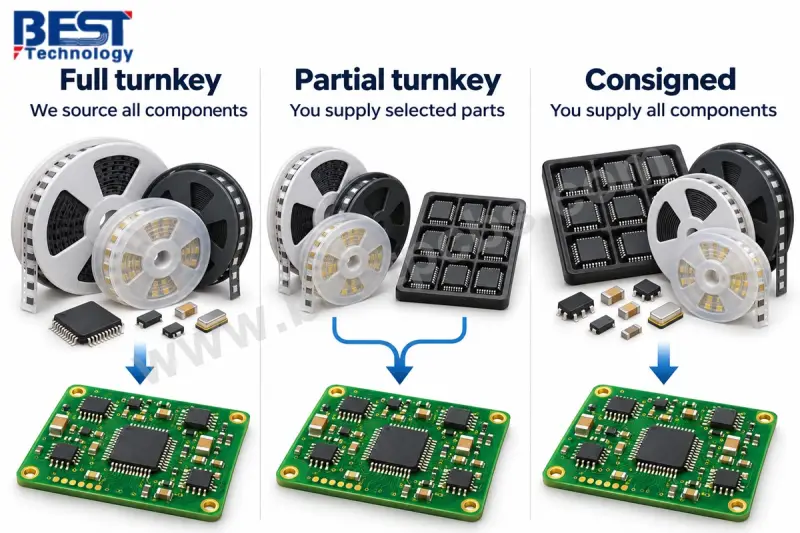
Turnkey, Partial Turnkey or Consigned: Choosing the Purchasing Model
The three service models change who buys what. They don't change the function of the finished board, but they do change who carries the risk when a part is late, substituted or wrong.
| Service model | Component purchasing | Suitable situation |
|---|---|---|
| Full turnkey | We source the BOM components and provide PCB fabrication and assembly. | Your team wants a single supplier to manage the complete build. |
| Partial turnkey | You supply selected components, and we source the remaining items. | You already hold critical ICs, proprietary parts, or allocated stock. |
| Consigned assembly | You supply the components for assembly, with PCB supply agreed separately. | Your purchasing team controls the complete component supply. |
Partial turnkey is the model that tends to fit real product teams. If your design uses a customer-programmed device, or you already hold an expensive processor, keeping that part under your control while the assembler buys the resistors, capacitors and connectors makes sense. The trade-off is timing: the assembly can't start until every part you own has arrived at the factory, so your own purchasing schedule becomes the critical path.
Sourcing Components Against the BOM
EBest Circuit says it sources parts from manufacturers or authorized distributors and checks incoming material against the customer's bill of materials. For procurement, that gives a defined target: the specified manufacturer part number, package, quantity and approved alternatives.
A BOM line that only says "10 kΩ, 0603" is dangerous. Several devices share a resistance value and package while differing in tolerance, voltage rating, temperature range or electrical behavior. Exact manufacturer part numbers keep an apparently equivalent part from slipping in. The sourcing review EBest Circuit describes focuses on four things:
- Part identification: manufacturer part numbers and reference designators tie each purchased item to its location on the board.
- Availability: stock levels and supplier lead times show which parts may hold up the build.
- Package compatibility: the ordered package has to match the PCB footprint and the assembly data.
- Alternatives: when a specified part is unavailable, the company can recommend substitutes for your engineering team to evaluate.
The rule that matters most here is that your team approves every substitution before it enters the build. A pin-compatible replacement can still need firmware changes, or shift analog performance, power draw or operating temperature. Treat a substitution as an engineering change, not a purchasing convenience.
Low-Volume Orders and What "No MOQ" Leaves Out
EBest Circuit states that it accepts low-volume PCB assembly with no MOQ, so a team can order what development, customer evaluation or a limited production run needs without padding the quantity to meet a factory minimum. For a small-batch buyer, that's a meaningful change: it lets you validate a design with real assembled boards before committing to a larger run.
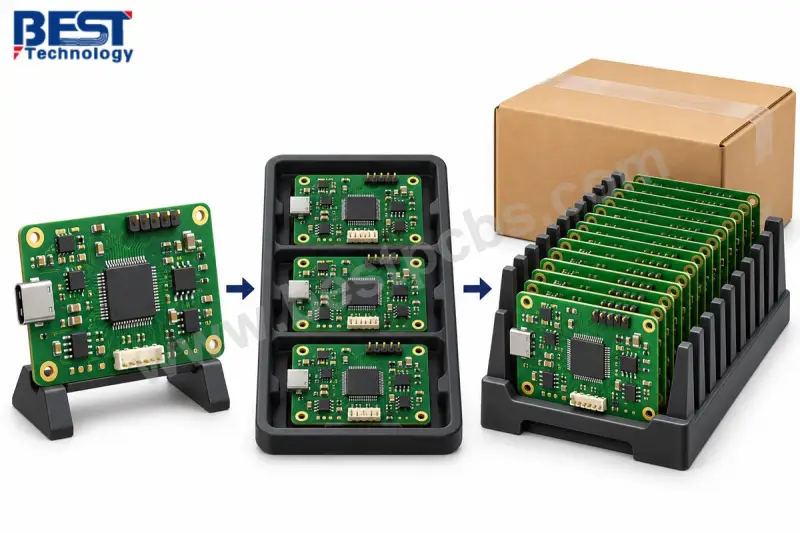
Small batches still carry the full process. An industrial controller with compact processing components and large terminal blocks needs both soldering routes and an inspection plan matched to its packages, even if the run is only a handful of boards. The count of boards doesn't reduce the number of process steps.
No MOQ also doesn't remove setup costs. A stencil or a dedicated test fixture may still be needed for a small order. A quotation should separate those one-time charges from the cost of each assembled board, so you can see what happens to the per-unit price when you order again.
Inspection and Test: What Each Method Catches
EBest Circuit describes three inspection methods and functional testing, each covering a different stage. SPI checks paste deposits before placement. AOI checks visible placement and solder features. X-ray examines joints hidden under packages such as BGAs. Functional testing checks whether the board behaves as specified. Each one has a blind spot the others cover, which is why the inspection plan should follow the components on your board.
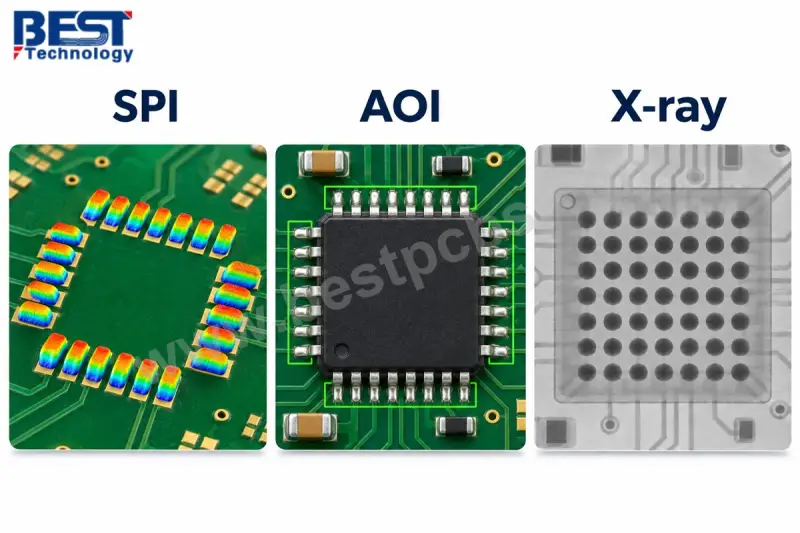
| Method | What it checks | Typical findings |
|---|---|---|
| Solder paste inspection (SPI) | Paste deposits before component placement | Insufficient paste, excessive paste, and deposit misalignment |
| Automated optical inspection (AOI) | Visible component placement and solder features | Missing or shifted components, visible bridges, and detectable orientation errors |
| X-ray inspection | Joints hidden beneath packages such as BGAs | Solder bridges, voids, and abnormal solder distribution |
| Functional testing | Operation under the specified test conditions | Incorrect outputs, failed interfaces, and operation outside defined limits |
A board can pass every optical check and still fail at power-up. That's the gap functional testing fills. What it verifies depends entirely on what you define: your firmware, your test procedure and your pass/fail limits. A controller might need its supply rails measured, firmware loaded and its communication ports exercised. A power board might need output measurements under a stated load. If you don't write those criteria down, the test will verify whatever the assembler decides is reasonable.
EBest Circuit also says its MES system supports board-level traceability. In practice, that means a board's identification and recorded manufacturing history can be pulled up if a fault shows up in the field. That's useful for narrowing an investigation to affected units instead of recalling a whole shipment, though it only helps if your own lot and serial records are linked to it.
PCB Types and the Assembly Trade-offs Each One Brings
EBest Circuit lists support for multilayer, HDI, RF and high-frequency, high-speed, metal-core, flexible, rigid-flex and ceramic assemblies. The substrate changes how paste prints, how heat moves through the board and how carefully the assembly has to be handled. The company's own summary makes the point well: board construction and assembly have to be considered together.
| PCB type | Assembly considerations and manufacturing support |
|---|---|
| FR-4 and multilayer PCB | Mixed component sizes and large copper areas can create uneven heating; our process review covers the reflow profile, through-hole operations, and board support. |
| HDI PCB | Dense layouts and fine-pitch BGAs require controlled paste deposits and placement clearances; stencil review, precision SMT, and X-ray address these assembly features. |
| RF and high-frequency PCB | RO4003C, RO4350B, and RT/duroid 5880 are available material options; assembly planning covers laminate handling, RF connector placement, and any shield attachment or RF test requirements. |
| High-speed PCB | Fine-pitch processors and connectors need accurate placement and inspection; functional testing can include specified interface checks using the customer's firmware and test setup. |
| Metal-core PCB | Aluminum or copper bases spread heat during soldering; the soldering profile must account for the board's thermal response and the temperature limits of its components. |
| Flexible and rigid-flex PCB | Flexible sections need support during printing and placement; carriers and controlled handling help keep the assembly flat and protect bend areas. |
| Ceramic PCB | Al2O3, AlN, and Si3N4 substrates require careful handling; board support and soldering-process review address brittle edges and differences in thermal expansion. |
The RF and metal-core rows deserve a closer look if you're designing those boards. A laminate's behavior under reflow and an aluminum base's heat spreading both push the soldering profile in directions that a standard FR-4 recipe won't follow. Ask the assembler how it handles your specific material, not just whether it can handle the category.
What Drives Chinese PCB Assembly Cost
Cost depends on the bill of materials, order quantity, board construction, assembly operations and testing. On many designs the components dominate the total. A board with expensive processors, power devices or connectors can cost far more in parts than in placement, even when the assembly itself is simple.
- Component prices, availability and purchase quantities set much of the material cost.
- Double-sided placement, fine-pitch packages and extra through-hole operations add process steps.
- Layer count, materials, copper requirements and special features drive fabrication cost.
- Stencils, support fixtures and test fixtures add setup costs, some of which carry over to an unchanged repeat order.
- Programming and functional testing add time per board, especially with multiple interfaces or load conditions.
Setup allocation is where small orders get expensive. As an illustration only, not an EBest Circuit quotation, a hypothetical $150 setup charge adds $15 per board on a 10-board order but $1.50 per board on a 100-board order. Component and processing costs sit on top of that in both cases.
For overseas purchasing, compare the delivered cost per usable assembly. Check whether the quotation includes freight, packaging, test fixtures, programming and destination charges. Component minimum purchase quantities can also leave surplus stock, so settle who owns that excess before the order starts. Cost reduction usually comes from removing unnecessary work: standardizing suitable passive parts simplifies purchasing, and accessible test points shorten the time needed to test each board.
Lead Times and Overseas Delivery
Assembly lead time starts when materials are ready and the production work can begin. International transit is a separate leg, and it's easy to blur the two. A board can't enter assembly while a required IC or its bare PCB is still missing, so the last part to arrive often sets the start date.
EBest Circuit describes a 1–5 day range for its quick-turn assembly options on urgent orders. The company says eligibility depends on reviewing complete files, available boards and components, order quantity, assembly operations and test preparation. That range does not include component procurement or international shipping, so a fast assembly slot doesn't guarantee a fast arrival.
- PCB fabrication: layer count, special materials and extra processes determine when bare boards are ready.
- Component readiness: the last required BOM item often controls the assembly start, including customer-supplied parts shipped from overseas.
- Assembly: single- or double-sided placement, through-hole work and line capacity set the production slot.
- Testing: firmware, instructions and any test fixtures must be ready before the test operation.
- Shipping: destination, chosen service and customs clearance determine arrival after dispatch.
A build with finished FR-4 boards, a complete component kit and an existing test fixture is far easier to schedule than one waiting on a specialized laminate or a new fixture. Those conditions help establish feasibility. They don't automatically earn the shortest turnaround.
Give the supplier a required arrival date at your facility rather than only a desired ship date. That lets the factory work backward through material arrival, manufacturing and shipment against one target, and it leaves room for engineering questions that cross time zones.
Vetting the Supplier Before a Larger Commitment
EBest Circuit positions its no-MOQ ordering and free DFM review as a way to evaluate the service with a small first order. That's a sensible approach for any overseas assembler, and it's worth structuring the trial around your board's real risks rather than a generic checklist.
Start by connecting the factory's stated capabilities to your board: its smallest package, the soldering sequence for mixed-technology parts, the inspection methods you need and the test method you'll use. Ask for current certificates, and check the site and activity scope they cover. Relevant production records for similar boards will tell your quality team more than a general capability sheet. A factory visit or live video walkthrough can connect a listed equipment line to the work actually happening on it.
A few questions come up repeatedly with first-time overseas buyers:
What should I verify about a PCB assembly manufacturer in China?
Cover the manufacturing site, the scope of current certifications, the assembly equipment and records for work similar to your board. A trial order with defined inspection and test results lets you judge execution before scaling up.
What costs tend to be left out of an overseas quote?
Stencils, fixtures, programming, functional-test development, surplus components from minimum purchase quantities, packaging, freight and import-related charges are common omissions. A good quotation separates one-time charges from recurring costs and states which destination expenses are yours.
Can I supply only the expensive or long-lead components?
Yes, under a partial turnkey arrangement. Your component list should identify which parts you provide and when they'll be available at the factory.
What happens if a BOM part becomes unavailable?
The assembler can recommend an alternative for your engineering team to review, or you can plan around the specified part's availability. A replacement has to meet the electrical, package and operating requirements. Matching the footprint alone isn't enough.
Do I need to supply firmware for functional testing?
If the test requires the board to run your application or dedicated test firmware, yes. You'll also need to provide programming instructions and expected results. Basic electrical checks may not need firmware at all.
Does a quoted lead time include international shipping?
Usually not. The quotation should separate the planned dispatch date from the estimated arrival date at your destination and service level.
Where This Model Fits and What to Watch
A single supplier covering fabrication, sourcing, SMT and through-hole assembly, and test is a practical arrangement for overseas teams that want fewer handoffs. The trade-offs don't go away: component cost stays with the parts, setup costs stay with the order, and transit stays a separate line item. The buyers who get the most from this model are the ones who decide early which parts they own, write down their test criteria, and ask for a quotation that shows every cost layer. That's the groundwork that makes the first small order a reliable test of the production run that follows.