Five Steps to Build a 2027 Electronics Supply Risk Plan
- adam-fleischer
- 773 reads
Map vulnerable parts, set inventory rules and review supplier commitments before 2027 production buys begin.
A workable 2027 supply plan needs owners, deadlines and part numbers attached to each risk. That matters now: component prices are shifting, some MLCC families are being discontinued, and Micron expects memory to be harder to source in 2027 and 2028 than it is today. A plan completed before year-end can guide contract renewals and first-half production buys while engineering works through alternate-part qualifications.
One industrial equipment maker is already dealing with both price and lifecycle changes. STMicroelectronics automotive MCUs rose 15 to 20% before a third price increase in August 2026. In September, Murata was reported to be phasing out selected general-purpose MLCCs used on several of the maker’s boards. The MCU increases affect the cost model; the capacitors need engineering review. These are different problems, but both become easier to manage when the response path is settled in advance.
Why settle the plan before year-end
Memory supply is a particular concern. On September 30, Micron CEO Sanjay Mehrotra said the company had committed more than 75% of its 2027 output to customers. Buyers who postpone forecasts until spring may find less uncommitted supply available. Micron also expects memory availability to be tighter in 2027 and 2028 than it is today.
The calendar adds pressure. Contract renewals and first-half production buys often converge in the first quarter. A plan agreed in December can shape both; one completed in March may come too late to guide the earliest orders. The team should agree on which parts need protection, who can approve extra inventory, and when engineering must qualify alternatives. Qualification work can then continue on its own schedule.
Start with the approved vendor and manufacturer lists. Flag single-source parts, parts tied to one production region, and items without a qualified alternate. Add components marked not recommended for new designs (NRND) or end of life (EOL). Then build the following five practices into a short plan.
1. Audit approved parts and their supply paths
For each flagged part, establish where it is fabricated and assembled. Visibility into a direct supplier does not necessarily reveal the wafer fab or assembly site farther upstream. McKinsey’s 2025 survey found that 95% of 100 companies had visibility into at least tier-one supplier risks, while 42% had visibility into tier two or beyond. Ask suppliers and distributors for site information, and check whether apparently separate approved sources depend on the same facility.

Review memory lifecycle status by part number, not just by technology. After Micron issued EOL notices for DDR4 and LPDDR4 in June 2025, it said supply would continue for long-term customers. Get written confirmation covering the specific part numbers, quantities and support period available to your account. A broad assurance about a memory type does not establish supply for a particular build.
MLCCs need a separate check. Japanese and Korean manufacturers are shifting capacity away from some consumer parts toward AI applications. Dell, HP, ASUS and Acer have begun qualifying Chinese manufacturers Viiyong and Chaozhou Three-Circle. Flag MLCCs sourced only from Japanese and Korean makers, then ask engineering to prioritize alternate qualification according to production need.
Finish the audit with a ranked list for engineering. Each entry should identify the affected part, its exposure and a qualification deadline linked to the build that needs it.
2. Define inventory buffers for parts that can stop a build
Call a component critical when a shortage would halt production or delay a customer delivery. Give priority to single-source, long-lead and allocated parts. For each one, check whether usable stock and confirmed open orders cover the scheduled builds, with each delivery due before its required build date. Assign an approver for additional safety stock: extra inventory ties up cash and may involve orders that cannot be cancelled.
Reported lead times show why this review belongs in the year-end plan. In August 2026, TrendForce News reported that power device lead times were mostly above 30 weeks, with some reaching 52 weeks. At those durations, many power parts need orders roughly seven months before a build; some single-source items may need ordering a year ahead. For memory, send suppliers forecasts this quarter and record the quantities and delivery dates they actually accept.

Engineering’s hard-to-replace-parts watchlist is a useful starting point. Once the bill of materials (BOM) is frozen and production purchasing begins, procurement can set stock alerts against production quantities. The plan should make clear which shortages trigger action and who owns that action.
3. Measure supplier performance beyond price
Price and on-time delivery remain useful scorecard measures, but they don’t show the full picture when supply tightens. Add four checks: whether a supplier is authorized for the product line and can trace parts to the manufacturer; how accepted quantities and dates compared with actual 2026 shipments; how promptly and completely lifecycle notices arrived; and what cancellation or rescheduling terms apply, including who pays for excess stock if demand falls.
Keep lifecycle status and country of origin attached to each component record. They describe the part rather than the supplier. Weigh the supplier measures alongside price, then rescore at quarterly plan reviews. Compare origin-based quotes using landed cost at current duty rates: a higher base price from another source may produce a lower total cost.
4. Test the plan against a dated cost change
Use one specific event to see whether the plan gives the team enough time and authority to respond. For programs importing into the US, June 23, 2027 is a useful planning date: a scheduled increase affecting China-origin chips moves from a current 0% rate to a level to be published at least 30 days beforehand. A separate 50% rate has applied since January 2025 to listed China-origin parts in Harmonized Tariff Schedule headings 8541 and 8542.
For affected BOM lines, identify which parts have a qualified source outside China. Compare landed costs under two or three plausible rates, and check purchase terms to establish who bears the added cost. Then consider whether bringing parts into the US before June 23 would justify the cash tied up in stock, storage expense and risk of obsolescence.
The relevant rate generally depends on when goods enter the US, rather than the purchase order date. Before changing order timing, confirm classification, origin and entry timing with the customs broker or distributor acting as importer of record. Also put two earlier dates on the planning calendar: the stated suspension of China’s restrictions on gallium, germanium and antimony exports to the US ends November 27, 2026, and a US-China trade truce is scheduled to run through January 10, 2027, unless extended. Revisit the scenario when the June rate is published and adjust affected quantities and order dates.
5. Track lifecycle status across every active BOM
Murata’s reported MLCC discontinuation illustrates why notices need explicit dates and part-level confirmation. Distributor Component Sense reports selected part numbers across nine series, with written confirmation of requirements due by December 31, 2027, a last order date of March 31, 2028, and last shipment by March 31, 2029. Obtain the notice from Murata or an authorized distributor, confirm which of your parts it covers, and add the confirmation deadline to the plan calendar.
Ask each supplier how much warning it provides before discontinuing a part and whether it follows IPC/JEDEC J-STD-048A, a product discontinuance notification standard. Between quarterly reviews, give one person responsibility for incoming manufacturer and distributor notices. That person updates the exposure list and alerts engineering when a part on an active BOM is affected.
At each quarterly review, check every active BOM for lifecycle status: Active, NRND, EOL or Unknown. Add new NRND and EOL entries to the exposure list, and verify Unknown entries with the manufacturer. The Octopart BOM Tool can display these statuses for matched lines, but each uncertain part still needs confirmation.
Keep the working plan to one page
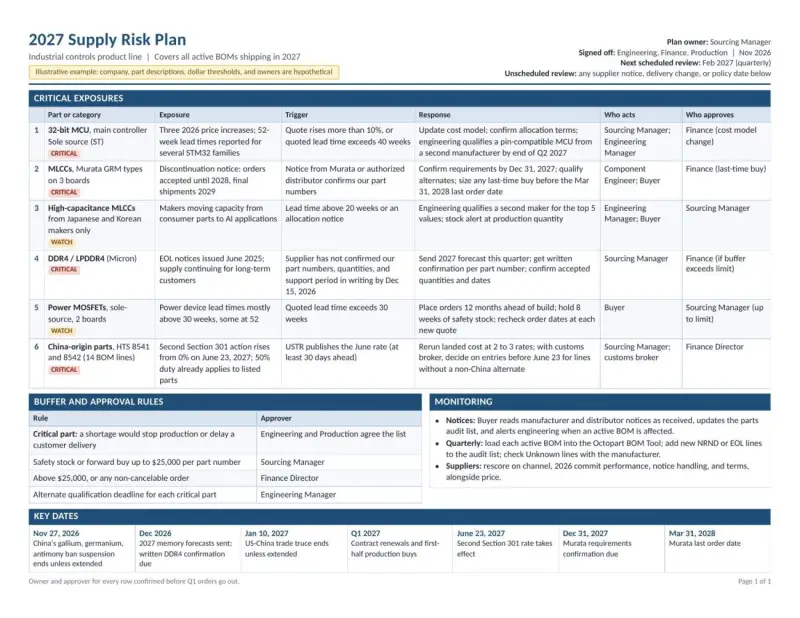
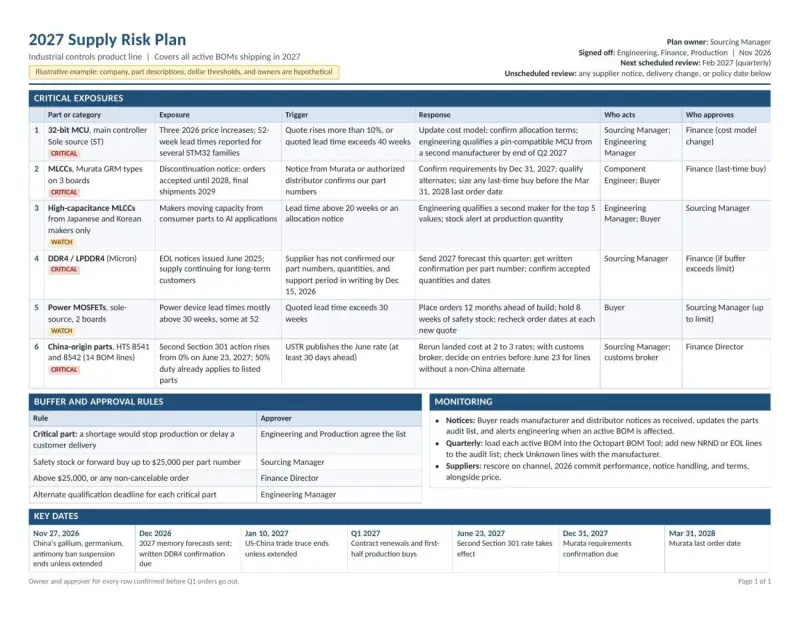
A compact plan is easier to use when a price change or discontinuation notice arrives. For each critical exposure, record the trigger, the person responsible for acting, the approval owner for extra inventory or spending, and any engineering qualification deadline. Review it quarterly and whenever supplier notices, delivery changes or dated cost events affect the plan.
Start by loading active BOMs into a lifecycle check and filtering for NRND and EOL parts. That list gives procurement, engineering, finance and production a shared starting point. The aim is to review a one-page draft before December contract renewals close, so the first 2027 orders follow agreed rules rather than improvised decisions.