Irish Demonstrator Tests Ecocem ACT Low-Carbon Concrete in Precast and Ready-Mix Production
- Sarah
- 397 reads
A two-storey Dublin demonstrator is assessing ACT concrete’s strength, durability and suitability for Irish production and construction.
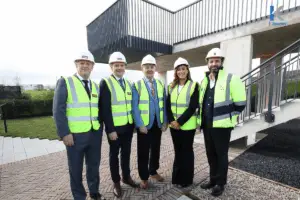
A two-storey demonstrator in Dublin is putting Ecocem’s ACT cement technology through production and construction checks in Irish conditions. The project brings together Kilsaran, Ecocem, Cairn and University College Dublin (UCD), with Kilsaran supplying and evaluating concrete for both ready-mix and precast applications. Its results are intended to help build the technical case for using lower-carbon cementitious materials more widely in Ireland.
The location is Cairn’s Innovation Hub at Seven Mills, where the standalone structure provides a real-world setting for assessing ACT concrete. That setting matters: a material needs to work through the stages between mix production and use on a building project, not just meet a laboratory target. The partners are examining ACT in production, manufacturing and on-site construction, so the demonstrator can show how the material performs across different practical applications.
Evidence from production to construction
Kilsaran’s contribution spans ready-mix concrete and precast elements. The precast components used in the structure were manufactured at the company’s facility in Oranmore, County Galway. By supplying and evaluating ACT concrete across these two routes, Kilsaran is assessing how the technology fits into existing concrete production and building practices.
That breadth is useful because ready-mix and precast work involve different production and delivery settings. A technology that is compatible with established processes has a clearer route to trial across real projects, but it still has to meet requirements for strength, quality and practical use. The demonstrator allows the partners to examine those requirements in the context of an actual structure. The project information does not provide detailed mix proportions, test methods or measured results beyond its reported initial findings, so those details will be important when judging how far the findings apply to other projects.
Ecocem says ACT could reduce cement-related CO₂ emissions by up to 70% compared with conventional European cement. The company says the technology is compatible with existing manufacturing and construction processes. It was developed over more than a decade at Ecocem’s research and innovation centre near Paris. These are the technology’s stated potential and design goals; the Dublin demonstrator is examining how the concrete performs in local production and building conditions.
Early performance and the route to wider use
Initial testing has shown ACT concrete reaching the required strength levels after 28 days. The project also reports durability and lifespan performance comparable to traditional cement-based concrete. Those findings address key questions for a lower-carbon material: whether it can meet strength expectations and whether its durability is comparable to familiar concrete. The available information does not specify the test conditions or provide numerical strength values, so the reported results are an early indication rather than a complete basis for comparing mixes.
The work is partly funded by a €50,000 award from Construct Innovate’s Seed Fund. Its stated aim is to generate technical evidence that can support certification and wider market acceptance of new cement technologies in Ireland. The project also feeds into ongoing work on standards development, which can help establish pathways for lower-carbon cementitious materials to enter the market.
For engineers and concrete producers, the practical question is whether a material can move from promising performance claims to consistent use in specified applications. Evidence from ready-mix production, precast manufacture and construction can help answer that question. The demonstrator’s value will depend on the detail and scope of its results: what was tested, under which conditions, and how those findings relate to the strength and durability requirements of future projects.
Concrete producers’ role
David McKeown, Kilsaran’s Co-CEO, said concrete producers have a central role in reducing construction’s carbon impact because they translate cement technologies into concrete for manufacturing and on-site use. He said Kilsaran is applying its expertise in both ready-mix and precast concrete with the project partners to assess ACT in production and construction.
McKeown described demonstrating that lower-carbon concrete can meet requirements for strength, quality and practical use as an important step toward wider adoption. That places the producer’s role at the centre of the trial: the cement technology must be made into concrete that works within familiar production and building processes, while the project gathers evidence about its performance.
The Dublin demonstrator is one contribution to a broader European push to develop lower-carbon cement technologies. For Ireland, its most useful outcome will be evidence that helps project teams evaluate ACT against the requirements of actual applications. As testing and standards work continue, the results from this structure can help clarify where the material is ready for consideration and what further evidence is needed for wider use.