NVIDIA GTC Berlin 2026: Industrial AI Agents, Robot Simulation and Data Center Power
- Satyajit Sinha
- 855 reads
GTC Berlin showed AI agents working inside engineering tools and factories, while simulation and power management expose the limits of deployment.
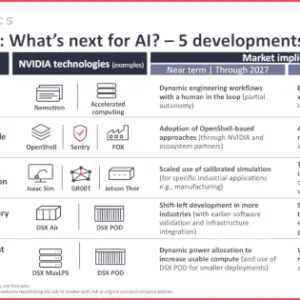
NVIDIA’s GTC Berlin demonstrations put a practical question at the center of industrial AI: what has to be in place before software that predicts and acts can deliver reliable results on real equipment? The company showed agents using established engineering tools, robots trained through simulation, and data center designs aimed at shortening deployment. Each demonstration also revealed a dependency: the tools need design software and solvers, robot models need physical measurements, and AI infrastructure needs prepared sites with power and cooling.
The conference ran October 20–22, 2026, NVIDIA’s second European AI conference after GTC Paris in 2025. Across engineering software, factory operations, robot simulation and data center infrastructure, the pattern was consistent. NVIDIA supplied computing and software building blocks; manufacturers, software vendors and operators supplied much of the data, equipment and site knowledge that made them useful.
Agents work inside established engineering software
Cadence and Dassault Systèmes demonstrated agents that translate an engineering goal into actions within their existing design and simulation environments. The agents extend those tools by coordinating steps; they don’t replace the underlying solvers, design data or engineering review.
In a booth demonstration, Cadence’s AuraStack took the request “check and fix any IR reliability with pre-layout analysis,” planned a sequence of actions, then ran Cadence layout, thermal and signal-integrity tools using shared design context. Cadence launched AuraStack, for circuit-board and advanced-packaging design, in July 2026. The meaningful part of the demonstration was the link from a plain-language engineering objective to execution in specialist software.
Dassault Systèmes showed a related workflow in its keynote. Its AURA planning agent and LEO sub-agents adapted a Volkswagen Golf door design for the Tiguan in CATIA, identified a vibration issue in SIMULIA and refined the design. An engineer chose the final version.
These examples leave the established software vendors in control of the tools and solvers. NVIDIA provides computing infrastructure and, in selected implementations, models and agent runtimes. That arrangement may help incumbents extend their products, but it doesn’t establish how reliably the agents work. Neither demonstration supplied independent error-rate evidence. Engineers still need to inspect results and approve consequential decisions, while the business case depends on whether shorter design cycles and earlier launches justify implementation and inference costs.
Runtime controls shape what agents can do
As agents gain access to files, credentials and tools, permission checks inside a model are a weak boundary. NVIDIA argued at the conference that an agent’s instructions can’t serve as the control that determines which actions it may take. “Today, the only thing stopping an agent from misusing all that is asking it nicely. … But hope isn’t security,” the company said during its October 21 keynote presentation.
NVIDIA’s open-source OpenShell runtime places policy checks outside the agent. A supervisor checks outbound requests and releases credentials only to approved endpoints. A gateway manages sandboxes and policies, while a policy prover checks proposed permission changes using formal verification. Sentry, an optional layer on NVIDIA BlueField-4 data processing units (DPUs), is designed to monitor and enforce policy independently of the host through hardware isolation.
At a factory booth, NVIDIA showed its Factory Operations Blueprint (FOX) on a circuit-board production line. One agent, using NVIDIA’s Cosmos model, rechecked parts rejected by an automated optical inspection machine. Another searched machine data, traced excess solder to paste build-up on a printer sensor and created a maintenance work order. The agents could read data and create work orders, but couldn’t edit factory logs or change machine settings. A technician handled the repair.
Siemens described a similar division of responsibility at its Erlangen factory: AI agents propose production schedules, and a planner approves a schedule. In both cases, limited permissions make the agent useful for analysis and preparation while keeping operational decisions under human review.
NVIDIA says OpenShell has support from other companies, which signals interest in the approach; it doesn’t establish widespread production use or a settled industry standard. Its policies can limit access to files, networks, credentials and tools. They don’t replace programmable logic controller (PLC) safety functions, industrial interlocks or human approval when machine settings need to change. For factory operators, defining and validating those boundaries is part of the deployment work.
Robot simulation depends on physical measurements
Simulation can cut the need for repeated physical trials, particularly where robot training data is hard to collect. But a simulated skill still has to match the forces and behavior of the real system. That makes measurement and calibration as important as the ability to run more simulations.
At Synopsys’s booth, robot simulation company Lightwheel demonstrated how it calibrated a model using force measurements from a real robot arm pushing an Ethernet cable into a socket. Synopsys owns Ansys, whose physics solvers Lightwheel said it uses because standard simulation did not match forces measured on real robots.
For this single cable-insertion task, Lightwheel reported a normalized root-mean-square error (NRMSE) of 4.4% between its calibrated simulation and measured force curves across five trials. That figure describes the reported comparison for this specific setup. It doesn’t demonstrate transfer to other cables, tasks or robot arms.
Germany-based motion technology company Schaeffler and robot software company Wandelbots showed another step toward deployment: an electric-motor assembly skill trained in simulation and run in a physical robot cell. Reusing a skill across robots and plants could make development more efficient, but each site still needs integration and safety checks.
NVIDIA’s simulation tools can give developers more opportunities to test and refine a model. They don’t provide the calibration data. That advantage belongs to physics-solver specialists and manufacturers with access to real robot cells and measurement equipment. The evidence shown in Berlin points first to structured tasks in controlled cells, where conditions can be measured and reproduced. A successful calibration on one task doesn’t show that the same method will work reliably across the broader range of parts, robots and environments needed for general-purpose machines.
Data center preparation starts before the racks arrive
When expensive GPUs are waiting for a site to become ready, delays have a direct cost. NVIDIA showed two ways to advance preparation before production hardware arrives: virtual checks of infrastructure and software, and physical preintegration of equipment at a factory. These are distinct approaches and can be combined.
NVIDIA DSX Air simulates infrastructure interfaces so operators can test provisioning and orchestration software before production racks arrive. At its booth, NVIDIA rehearsed data center software on a DGX Station. Cadence’s Reality digital twin addresses a different part of preparation: it checks power headroom, airflow and liquid-cooling effects for proposed racks before construction or an upgrade. Neither virtual method replaces performance, thermal or acceptance testing on the finished hardware.
NVIDIA announced the DSX POD reference design in October 2026. Manufacturing companies following the design complete rack cabling, piping and functional tests at the factory, then ship modules in containers to sites where power, cooling and network connections are ready. NVIDIA projects that deployment at a prepared site could fall from six months to as little as 14 days. Initial deliveries are targeted for early 2027, so the schedule improvement remains a projection.
The design shifts integration work toward equipment makers and electrical and mechanical suppliers, and may reduce the time GPUs wait for site work to finish. The trade-off is that each module may duplicate power and cooling equipment that a shared central plant could otherwise serve. That could increase lifetime costs, making factory-preintegrated modules more attractive where time to capacity matters more than the lowest-cost build. Preparation at the site is still essential: preintegration doesn’t remove the need for a grid connection, permits or final commissioning.
Power sharing raises throughput, with latency and energy trade-offs
Data center operators often reserve enough capacity for a GPU’s peak demand, even though live workloads may draw less. NVIDIA’s DSX MaxLPS software shares some of that unused headroom among nodes, within a power budget set by the operator. The aim is to run more computing under the same provisioned ceiling.
A test NVIDIA published in September 2026 with UK-based AI cloud provider Nscale offers a specific example. Nscale ran NVIDIA GB300 NVL72 systems under a provisioned limit of 264.4 kW. With static allocation, 140 GPUs ran three instances of the Kimi K2.5 model: two high-throughput jobs and one low-latency job. With MaxLPS, shared headroom supported an additional 52-GPU throughput job, bringing the total to 192 GPUs under the same provisioned limit.
NVIDIA reported a 49.2% increase in aggregate throughput. The added inference instance increased total output, while throughput for the existing instances remained virtually unchanged in this test. Measured power draw rose by 19.7%, and the reported 99th-percentile (P99) time to first token—the time before a request begins returning output—increased by 17%.
The fixed number was the provisioned ceiling; actual measured draw went up. NVIDIA also promotes MaxLPS as delivering the same tokens with up to 30% less power, but that is a different comparison from the Nscale test. For an operator constrained by available power, the useful metric is output from each reserved megawatt. Sharing headroom can put capacity to work, but sustained higher draw may raise electricity costs, latency may worsen for some requests, and workloads already close to peak power may leave little headroom to share.
The Nscale result is evidence from one model and workload mix, not a general performance guarantee. Operators would need to compare the trade-offs against their own workloads, including their latency targets and power budgets.
Deployment depends on proving predictable results
The conference connected several current approaches to industrial AI: agents that use engineering software, external controls on agent permissions, robot skills calibrated against physical measurements, earlier data center integration and software that shares power headroom. Each addresses a practical bottleneck, but none removes the need to validate outcomes in the environment where the system will operate.
That is the central challenge when probabilistic software enters industrial systems built around repeatable control. Predictions and recommendations need to produce results that engineers can validate for reliability and safety, especially when they influence physical machinery. Memory costs, available power and integration work also shape whether deployment makes economic sense.
NVIDIA is supplying important components of these systems, but customers and industrial software companies still control many of the assets that determine whether they work: solvers, plant data, measurement data and connected sites. The next measure of progress is not simply whether an agent can act or a simulation can run at scale. It is whether the resulting operation can be validated, repeated and maintained at a justifiable total cost.


