Industrial Wireless Hardware Market Set to Reach $4.08 Billion by 2030
- Satyajit Sinha
- 460 reads
Shipments are forecast to reach 6.6 million units by 2030 as mobile automation, resilient networks and wireless upgrades lift demand.
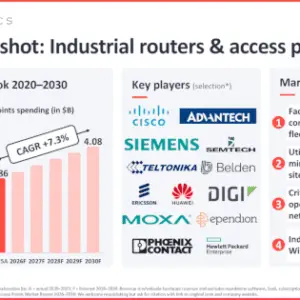
Industrial wireless hardware demand is being shaped by how factories and infrastructure operate: more mobile equipment needs coverage, remote sites need rugged links, and critical locations need backup paths. IoT Analytics estimates that revenue from industrial routers and access points will rise from $2.86 billion in 2025 to $4.08 billion in 2030, a 7.3% compound annual growth rate (CAGR). The growth rate is below the 9% recorded from 2020 to 2025, yet the forecast period adds more revenue: $1.21 billion, compared with $1.03 billion in the prior five years.
More units, similar average prices
Annual shipments are projected to increase from 4.6 million units in 2025 to 6.6 million in 2030. The blended average selling price (ASP) is expected to remain close to $620, with only a 0.5% cumulative increase over that period. Wi-Fi equipment is forecast to account for about 75% of the additional unit shipments. Cellular equipment contributes more to revenue growth as higher-priced 5G and RedCap routers make up a larger share of sales.
The figures cover wholesale hardware revenue. They exclude IoT gateways, industrial Ethernet switches, firewalls, private 5G infrastructure, software and services. That boundary matters when comparing the forecast with estimates that include broader network or computing systems.
Mobile equipment changes WLAN requirements
Factories and warehouses are adding automated guided vehicles (AGVs), autonomous mobile robots (AMRs) and other moving assets. These machines need dependable wireless coverage, but access point demand does not rise one-for-one with robot counts. Site layout, radio coverage, network topology and the number of endpoints all affect how much infrastructure a deployment needs.
In an April 2026 webinar, Cisco demonstrated its Ultra-Reliable Wireless Backhaul (URWB) technology on the industrial IW9165 and IW9167 access points, as well as selected enterprise Wi-Fi 6, 6E and 7 models. The approach lets one wireless infrastructure serve conventional Wi-Fi clients and moving industrial assets such as AGVs and forklifts, with shared network management tools. Cisco’s demonstration points to a competitive shift: enterprise WLAN vendors are extending their products into applications long served by industrial networking specialists.
Remote sites and backup links add hardware
Utilities, rail networks, ports and mines often connect equipment spread across large areas. New sites and network extensions call for rugged routers and wireless links; resilience requirements can add more units at existing sites. The practical result is that demand depends on network design and redundancy as well as the number of locations.
Teltonika Networks introduced its first 5G transport router, the ATRM50, in July 2025. Designed to connect onboard equipment in rail and other transport vehicles to external networks, it combines 5G with EN 50155 and EN 45545 rail certifications and has an operating range of -40°C to 75°C. The product announcement illustrates the requirements placed on cellular equipment that must operate in mobile transport settings.
Redundancy can multiply router counts at critical locations. In a project covering more than 1,000 existing-site migrations and more than 4,000 new sites, a European energy distribution company selected Advantech’s ICR-2431 LTE router. Standard sites use dual-SIM routers for network redundancy. Critical locations use two LTE routers on separate mobile networks in hot-standby mode, with satellite connectivity as a third backup path. The project description shows how resilience planning can drive equipment demand beyond the primary connection.
Wi-Fi 6/6E leads WLAN replacements; 5G lifts cellular value
The wireless upgrade cycle is uneven across technologies. Wi-Fi 6/6E and Wi-Fi 7 together are projected to account for 79.1% of industrial Wi-Fi revenue in 2030, up from 40.4% in 2025. Wi-Fi 6/6E remains the larger contributor, at nearly 70% of 2030 revenue; Wi-Fi 7 accounts for about 9%. The forecast therefore points to Wi-Fi 6/6E as the main WLAN replacement generation through the end of the decade.
For cellular equipment, 5G and RedCap are expected to generate 59.2% of revenue by 2030. Yet 4G/LTE is still projected to represent approximately half of cellular shipments. Higher-priced 5G/RedCap devices can increase revenue faster than unit volumes, while older cellular generations remain in use across many deployments.
Compatibility may shape purchasing decisions
Industrial routers and access points generally need less memory than industrial PCs and compute-intensive gateways, which may limit their exposure to memory-price increases. The modest projected ASP change suggests that compatibility could be a more pressing upgrade issue than hardware cost. New WLAN generations and security standards such as WPA3 can leave older operational technology (OT) devices struggling to stay connected.
For engineering teams, the purchasing question is therefore broader than radio performance. A replacement needs to work with existing endpoints, network management systems and equipment from other vendors. As factories and field operations adopt newer Wi-Fi and cellular generations, backward compatibility and interoperability will help determine how quickly those upgrades can be deployed.
The market forecast describes growth driven by more mobile endpoints, geographically dispersed operations, redundant network paths and equipment replacement. The key figures and product examples are attributed to IoT Analytics and the named manufacturers; the forecast covers hardware through 2030.


