IMTS 2026: Knowledge Graphs and MCP Shape a New Industrial AI Stack
- Knud Lasse Lueth
- 311 reads
IMTS 2026 put AI on the factory floor, with knowledge graphs, MCP servers and hardware interfaces pointing to a more connected industrial software stack.
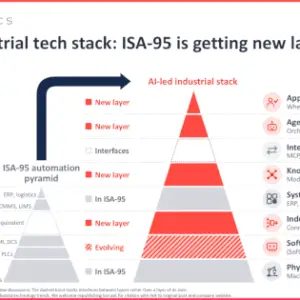
Industrial AI is starting to acquire a stack of its own. At IMTS 2026, manufacturers and software vendors described an architecture that keeps familiar systems such as ERP, MES and historians, while adding knowledge graphs, data tools, agent interfaces and applications that keep people involved. The shift matters because it changes how AI can reach operating data and, eventually, interact with equipment.
The International Manufacturing Technology Show ran September 14–19, 2026, at McCormick Place in Chicago. The biennial event has long focused on CNC machine tools, additive manufacturing and fabrication. This year, cloud providers, AI companies and industrial software vendors were prominent alongside those established areas. Google brought its factory AI pitch; OpenAI demonstrated an agentic maintenance system; and the Association for Manufacturing Technology (AMT), the show organizer, introduced an Industrial AI Arena.
A familiar automation pyramid gains new layers
The ISA-95 pyramid has traditionally organized factory software from shop-floor devices upward: sensors and PLCs, supervisory control and data acquisition, manufacturing execution systems and historians, then enterprise resource planning. Conversations at the show pointed to a broader arrangement. The established systems remain records of operational activity, while new layers handle software-defined edge computing, industrial DataOps, knowledge graphs and ontologies, agent interfaces, AI agents, and applications where people review or guide decisions.
That architecture is still taking shape. The useful distinction is that AI needs more than access to raw readings or documents. It needs relationships: which asset produced a measurement, which production order it relates to, and what maintenance or design information helps explain it. Vendors are competing to provide that context and to connect it to the applications where engineers and operators work.
Knowledge graphs put context at the center
One of the clearest changes was the emphasis on knowledge graphs in place of a single centralized data lake as the main organizing layer. For years, cloud strategies often began by copying plant data into a common repository before analysis. AWS presented a different approach through its Industrial Data Fabric: connect information where it already resides across MES, SAP, product lifecycle management (PLM) and operational technology historians, then add relationships that make the data meaningful.
AWS uses Amazon Neptune for knowledge graphs and showed an orchestrator that queries MCP servers connected to ERP, MES, computerized maintenance management systems (CMMS), PLM and its SiteWise historian. It can assemble a graph as needed, rather than requiring every data source to be consolidated first.
Steve Blackwell, AWS Head of Product Engineering & Services, CoE, said the graph was part of the company’s Industrial Data Fabric from its launch, providing context by linking industrial IoT data to systems such as MES and SAP. He said Amazon Bedrock Agent Core adds GraphRAG, allowing an agent to work with the graph to reason over connected information and answer questions.
MachineMetrics made the commercial argument directly. The US industrial software company began with machine monitoring and now positions its MaximaOS platform as a manufacturing execution system. Chief Revenue Officer Graham Immerman described the company’s knowledge graph as its “moat”: its data schema and context, he said, are what distinguish a platform when building a user interface has become easier.
The practical test will be whether these relationships stay useful across plant systems and applications. A graph can help an agent connect a machine condition to production and maintenance records, but its answers depend on the quality and meaning of those links. Context is becoming a product feature, not just a data engineering concern.
MCP connects agents to live industrial systems
The Model Context Protocol (MCP), introduced by Anthropic in November 2024 and now overseen by the Linux Foundation, gives AI agents a way to query software systems where data lives. That changes the traditional copy-first pattern, in which extract, transform and load jobs move information from isolated systems into a cloud data lake before analysis.
At IMTS, vendors including MachineMetrics, PTC’s Onshape, Rockwell Automation’s Emulate3D, Limble and Vention presented MCP servers. The protocol can make it easier to build an agent around existing applications, but the capabilities vary. A native server can expose application logic, potentially letting an agent make changes or run functions inside the software. A wrapper around a closed API may be limited to reading information; other servers may only transfer data, without the application knowledge needed for more meaningful work.
Vention Chief Product Officer Brendan Sterne described an MCP workflow for robot cell design. Using Claude Code, an agent could retrieve a design’s geometry and configuration, program it, upload the result and run it on a digital twin. The example illustrates the potential of connecting an agent to engineering software, while also showing why the quality of the underlying application interface matters.
Trust remains a practical constraint. Engineers need to see how an agent reached an answer before relying on it. AWS demonstrated an Engineering Assistant that displays its reasoning steps, queried systems, data sources and confidence scores. That kind of observability gives a person a basis for checking an answer, especially when it draws on several operational systems.
MHS extends the interface from software to equipment
MCP connects agents with software; Anthropic’s Model Hardware Standard (MHS) aims to give them a consistent way to discover and operate physical equipment. Released as a research preview on August 27, 2026, MHS describes devices such as robot arms, sensors and test instruments through a standard driver, simple “read” and “write” commands, and plain-language descriptions of capabilities and safety limits. Anthropic says the approach can reduce integration work that otherwise takes weeks or months to hours or minutes.
Early support is concentrated in laboratories, but Universal Robots, Doosan Robotics and AWS are among the companies adding support. Universal Robots tested the interface with four cobots, using Claude Opus 4.8 in Claude Code and its API-first PolyScope X control system. From natural-language instructions, the agent discovered the robots and their capabilities, configured them, and ran them as a cell, passing payloads between robots within each device’s declared limits.
Universal Robots called the setup a proof of concept and provided no performance figures. It did not demonstrate MHS on the show floor, but discussed the approach at the event. Chris Savoia, the company’s Head of Ecosystem, characterized it as a hardware connection framework that enables natural-language tasking and robot provisioning through Claude. Vention similarly described MHS as an introspection and control framework that tells an AI model which sensors and actuators it can use.
For engineers, the appeal is reduced custom integration between an agent and each device. The important detail is that the interface includes declared capabilities and limits: an agent needs to know not only how to issue a command, but what a device can safely do. The Universal Robots test shows the idea operating across multiple cobots, while its proof-of-concept status means it should be read as an early demonstration rather than a performance benchmark.
Vendors are taking different routes to autonomy
IMTS also exposed differences in how quickly suppliers are willing to give AI a role in physical operations. Fanuc, which had declined to discuss physical AI at Automatica 2025, showed two demonstrations with Google and AWS at IMTS. Both remained in research and development. Universal Robots appeared further along: it launched its Gen 7 cobot at the show as an open platform for AI applications.
Maintenance vendors also differ in how much independent action they want an agent to take. MaintainX cofounder Nick Haase described the company’s aim as being “a half step behind.” That cautious stance reflects a central deployment question: whether AI should recommend a maintenance action, prepare it for approval, or carry it out. At IMTS, the direction of travel was toward connected systems and tighter workflows, but people remain involved.
The broader opportunity is to close loops across software that has often operated separately, such as CMMS and predictive maintenance. Knowledge graphs can supply the connections, MCP can give agents access to applications, and hardware interfaces may extend that reach to machines. Whether those pieces work together in production will depend on data quality, the functions exposed by each vendor, and the visibility people have into agent decisions.
IMTS 2026 covered 10 technology sectors, from metal removal and additive manufacturing to software and automation, and added its first Industrial AI Arena. AMT reported more visitors than at the previous show, while floor space did not grow. The event’s AI story is therefore less about replacing the machine-tool focus than adding a software and autonomy layer around it.
The next engineering question is how much of that proposed stack vendors can make interoperable and dependable in day-to-day operations. The systems of record are staying put; the emerging work is connecting them with usable context, inspectable agent behavior and clearly bounded access to equipment.