European Refrigeration Attacks Show How Connected Controls Can Disrupt Store Operations
- IoT.Business.News
- 1,000 reads
Attacks on supermarket cooling systems exposed risks in aging controls and remote access, with temperatures reportedly reaching 50°C across seven countries.
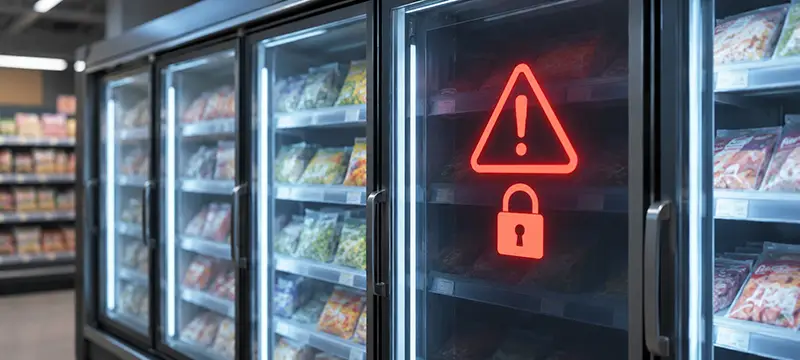
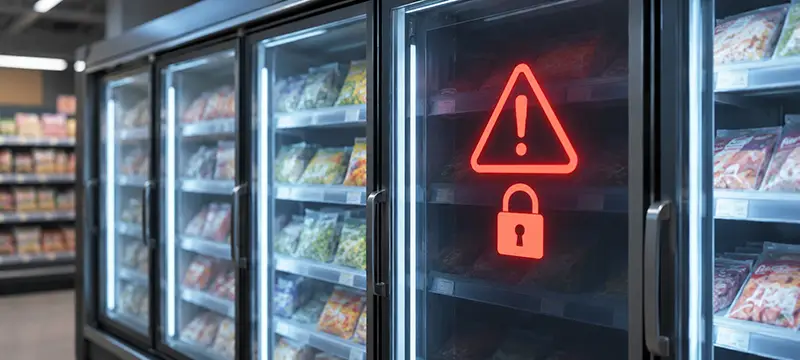
Connected refrigeration makes remote monitoring and control practical across large retail estates, but it also creates a route from network access to physical equipment. A recent series of attacks on supermarket cooling systems shows how that link can turn a security failure into spoiled stock and interrupted store operations.
On November 2, food retailers in at least seven European countries—Belgium, Sweden, the Netherlands, Estonia, Luxembourg, Finland and Ireland—reported disruption to refrigeration and freezer systems after suspected cyberattacks. Some units reportedly reached 50°C. The incidents followed a similar attack on October 12 that affected hundreds of French supermarkets and led retailers to discard refrigerated and frozen products.
Control commands with physical consequences
These incidents involved operational technology (OT): the controllers and systems that operate equipment, rather than corporate systems used primarily to store or process information. Reports from affected retailers and refrigeration service providers described remote changes to system settings, including altered temperatures and activated defrost cycles. A command issued through a connected control path can therefore affect stock and store operations even when no customer or business data is taken.
Commercial refrigeration is often installed to run reliably for years. That long service life creates a maintenance challenge: the physical equipment may remain useful while its software, remote access interfaces or security settings age. Systems can also be spread across many stores, warehouses and logistics sites, with remote servicing handled by outside providers. That combination makes it harder for an operator to maintain a consistent view of every device and every access route.
Reports associated the installations affected in these incidents with refrigeration management systems supplied by Danfoss. The company indicated that outdated software and insufficiently protected network connections contributed to the events. The full extent of the attacks—and whether they were centrally coordinated—remains unclear.
Why network visibility matters
Iain Davidson, Head of Product Marketing at Wireless Logic, described the incidents as evidence that attacks on connected infrastructure can cause physical damage and financial losses, not only data exposure. Wireless Logic argues that device security alone may be inadequate when operators cannot readily update every controller or directly manage the security configuration of equipment from multiple manufacturers.
The company recommends network-level visibility, including AI-driven anomaly detection to identify unusual communications and block connections to potentially malicious IP addresses. That can give operators another way to spot suspicious activity across a distributed estate, particularly where older equipment has limited built-in security controls.
Network monitoring has limits. It depends on seeing the communications that matter, and commands sent through valid management channels or with compromised credentials may resemble authorized activity. Monitoring therefore works best alongside controls on who can connect, which systems they can reach and what changes they can make. A network alert can help surface an anomaly; it cannot by itself establish whether a temperature change is operationally justified.
Designing for recovery as well as prevention
For operators and system integrators, the practical task is to assess the whole deployment: controllers, communications links, remote management platforms and service access. Measures identified for these environments include limiting internet exposure, strengthening authentication for remote access, updating vulnerable software, segmenting operational networks and watching for unusual device activity.
Independent temperature alarms can provide a separate indication that a cooling process has drifted from its intended state. Defined incident-response procedures can help staff identify affected equipment and respond to unauthorized changes. These safeguards address different parts of the problem: access controls reduce opportunities for misuse, monitoring helps detect suspicious traffic, and independent alarms reveal the physical result.
Connectivity providers can contribute through network isolation, traffic visibility and controlled access, particularly when cellular links connect equipment at geographically dispersed sites. Those measures may add protection without requiring changes to every installed device, though they still need to fit the access and maintenance arrangements for each system.
The same engineering issue applies wherever connected controllers manage temperature-sensitive processes, including cold-chain logistics, pharmaceutical storage and manufacturing. As these supermarket incidents illustrate, protecting the control path is part of protecting the process itself. Operators will need clear ownership of software updates, remote access and monitoring if connected refrigeration is to remain both serviceable and safe for stock.


