Consumer Asset Tracking Market Forecast to Reach 31.4 Million Devices by 2030
- IoT.Business.News
- 818 reads
Berg Insight forecasts 13.4% annual growth in active consumer trackers across Europe and North America, with battery life and connectivity shaping product design.


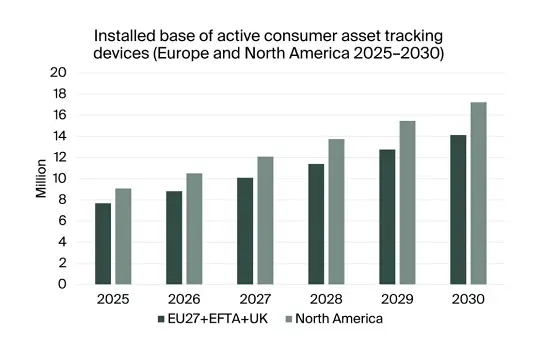
Consumer tracking devices are expanding into more use cases, but the market remains small compared with the number of pets, vehicles and children that could be tracked. Berg Insight counted 16.8 million active consumer asset tracking devices in Europe and North America at the end of 2025. Its forecast puts that installed base at 31.4 million by 2030, a compound annual growth rate (CAGR) of 13.4%.
The corresponding market value is forecast to rise from €2.3 billion in 2025 to €4.2 billion in 2030. The figures cover both devices and associated services, so the growth opportunity extends beyond hardware sales. The engineering challenge is to make each tracker practical for its intended use: small enough to attach to an animal or bicycle, able to operate on battery power, and connected where it needs to report its location.
What the forecast counts
The study focuses on consumer asset tracking systems that use wide-area networks: cellular, satellite, LoRa or Sigfox. It excludes devices that depend only on Bluetooth or Wi-Fi, including familiar proximity tags that rely on nearby phones or networked access points to help locate an item.
That boundary matters when interpreting the numbers. The count describes devices with a connection suited to reporting over a wider area, rather than every consumer product that can help find a lost object. A tracker with wide-area connectivity can report location beyond the immediate range of a phone, but its usefulness depends on the network available to it, the device’s power budget and the service behind the hardware.
Low penetration leaves room for growth
Berg Insight estimates that GPS tracking products have an overall penetration rate of approximately 1.2% in the markets covered. Its estimate of potential applications includes more than 380 million dogs and cats, approximately 620 million passenger cars, 160 million other consumer vehicles and nearly 70 million children aged 4–10. The latter group is a primary audience for GPS-enabled watches.
Those figures point to a large pool of potential use cases, but they don't mean every pet, vehicle or child is a likely customer. Adoption depends on whether a tracker solves a specific problem well enough to justify the device and any continuing service costs. A pet owner may value location alerts and activity information; a vehicle owner may prioritize theft recovery; a family may look for a watch that combines location reporting with communication features. Each application imposes different requirements on size, battery life, network access and software.
Pet trackers, children’s GPS watches and passenger car tracking products are currently the largest segments by active device count, according to Berg Insight. The market also includes dedicated products for motorcycles and bicycles. This variety makes a single performance measure, such as positioning accuracy, an incomplete guide to product suitability. A tracker’s operating time, physical form and ability to communicate in the relevant environment can matter just as much.
Specialist suppliers serve distinct applications
The supplier field is fragmented, with companies often focused on a particular category or region. Austria-based Tractive has approximately 1.8 million subscribers in pet tracking, while Fi and Halo are prominent providers in North America.
Child and family tracking draws on a different mix of businesses. Smartcom Mobility Solutions and Smith Micro Software supply platforms and white-label services. Xplora Technologies and US mobile operators serve the children’s smartwatch market.
Consumer vehicle tracking has its own set of providers. In North America, the named suppliers include Passtime GPS, Tail Light’s Bouncie and Agnik. European providers include Net4Things, Air and CarLock. Motorcycle products from Monimoto and GeoRide, alongside bicycle tracking systems from Bosch eBike Systems, PowUnity and IoT Venture, address more specialized equipment and mounting needs.
Corporate changes can alter how these services are assembled and sold. Tractive acquired Whistle Labs in 2025, and Bending Spoons acquired Tractive in 2026. The transactions illustrate a push toward scale and wider service portfolios in a market where subscriptions and software can be part of the offering alongside the physical tracker.
Connectivity and power shape product design
For device makers, power consumption is a central constraint. Trackers attached to pets, bicycles or personal belongings must balance size and battery capacity against the frequency of location updates and the demands of their radio connection. More frequent reporting can provide more timely location information, but it also increases the work the device must do. The appropriate balance depends on the use case.
Low-Power Wide-Area (LPWA) technologies can suit applications where long operating life is a priority and the connectivity requirements fit the network. Satellite links offer another option, particularly in places where terrestrial coverage is limited. The source data does not specify particular operating times, coverage levels or device costs, so those remain product-level questions for buyers and system designers to assess.
Software is also adding functions beyond location reporting. In pet tracking, AI-supported health and activity monitoring can turn movement data into additional insights about an animal’s behaviour and wellbeing. The value of those features depends on what information the device can collect and how clearly the service presents it to the user.
The forecast suggests room for more connected trackers, but growth will depend on matching hardware and networks to practical needs. For manufacturers and platform providers, battery autonomy, device size, network availability and the usefulness of the associated service all belong in the design brief. As adoption expands, the products most likely to stand out will be those that make a defined tracking task easier to carry out day after day.
Further details are available in Berg Insight’s Consumer Asset Tracking Solutions report brochure.