Connected EV Charging Points in Europe and North America to Reach 35.6 Million by 2030
- IoT.Business.News
- 613 reads
Connected charging points reached 12.9 million across Europe and North America in 2025. Berg Insight projects 35.6 million by 2030.
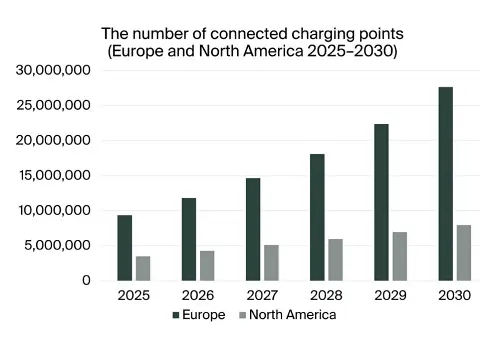
Network connectivity is becoming a defining part of EV charging infrastructure in Europe and North America. Berg Insight estimates that the two regions had 12.9 million connected charging points in 2025, and projects that number will grow to 35.6 million by 2030, a compound annual growth rate of 23 percent.
Europe accounted for about 9.4 million connected points in 2025, with connectivity penetration at 78 percent. North America had about 3.5 million connected points, representing 66 percent penetration. The figures show that connected equipment already makes up a substantial share of charging infrastructure in both regions, with Europe ahead on both total connected points and the proportion connected.
Software and charging hardware come from a mixed field of providers
Charging networks depend on back-office software to manage stations and their operation. That software comes from specialist charging-management companies, hardware manufacturers and charge point operators (CPOs). Some CPOs build their own platforms and also make them available to other operators as white-label products, giving those customers a way to run stations on software supplied by another company.
In North America, ChargePoint is a prominent example of a company combining several roles: it supplies proprietary hardware and software, operates as a CPO, and leads the region in charging points connected to its platform. Other providers with notable numbers of connected stations on their platforms include Blink Charging, Flo, EV Connect, SWTCH and Tesla.
Europe has a stronger presence of specialist software vendors with significant numbers of connected charging points. Berg Insight names Chargecloud, Last Mile Solutions, Monta, Virta, GreenFlux, Driivz and AMPECO as examples. Some hardware-focused companies, including Easee, Zaptec and Pod, also have many connected points. Their software offerings typically cover a narrower range of use cases than those of providers focused on managing charging networks.
The provider mix reflects different ways of assembling a charging service. A CPO can pair its own equipment with its own management platform, or use products from separate suppliers. White-label arrangements let a platform provider serve operators under another company’s brand. That flexibility can matter as networks expand, since the operator, equipment maker and software supplier may each have different responsibilities for station management.
European operators are moving toward specialist platforms
Full-service providers such as ChargePoint have a less prominent position in Europe than in North America. Shell Recharge Solutions and BP Pulse have narrowed their focus significantly in recent years, according to Berg Insight. The report also points to several European CPOs migrating their charging stations to platforms supplied by specialist software companies.
That shift suggests that some operators are choosing to separate station operation from software development. A specialist platform can serve multiple CPOs, while an operator can concentrate on running its charging network. The source describes this as a sign of increasing specialisation in Europe; it does not quantify how many operators have made the move or how much of the installed base is affected.
Connectivity can help manage operating costs
The growth projection comes amid uneven market conditions. Berg Insight IoT Analyst Caspar Jansson said EV and charging infrastructure sales have continued to rise, but at a slower and less even pace in recent years. He also described changing priorities and economic uncertainty as factors affecting the predictability of political support. Incentives and regulations continue to support the market, particularly in Europe.
Slower growth and difficult conditions have contributed to consolidation, cost-reduction efforts and strategic changes among equipment manufacturers, software providers and CPOs, Jansson said. Those pressures make operating efficiency a practical concern alongside the expansion of the network itself.
Charging demand can be large and intermittent. Jansson said that this can raise operating costs through demand charges, while volatile electricity prices add uncertainty. Connected chargers give operators a way to adjust output in response to electricity prices, grid capacity and vehicle needs. Managing charging in this way can help limit demand peaks and control costs, although the source does not provide a measured saving or describe a particular control system.
Home charging can benefit from similar coordination. Connected home chargers can shift charging toward periods when electricity is cheaper, align charging with household consumption and solar generation, and record charging for company vehicles to support reimbursement. For operators and vehicle owners alike, connectivity adds value when software can match charging activity to the conditions that shape cost and available power.
The projected rise to 35.6 million connected points by 2030 would put greater weight on the software layer used to coordinate charging. The split between integrated providers, hardware-focused companies and specialist platforms will shape how operators manage that growth. Berg Insight’s report is titled EV Charging Infrastructure in Europe and North America.


