Lasefinity Prices FusionX and WireX Metal 3D Printers From £24,999
- Michael Petch
- 310 reads
Sheffield-based Lasefinity offers compact powder-bed and fine-wire metal printers aimed at manufacturers and researchers testing new applications.
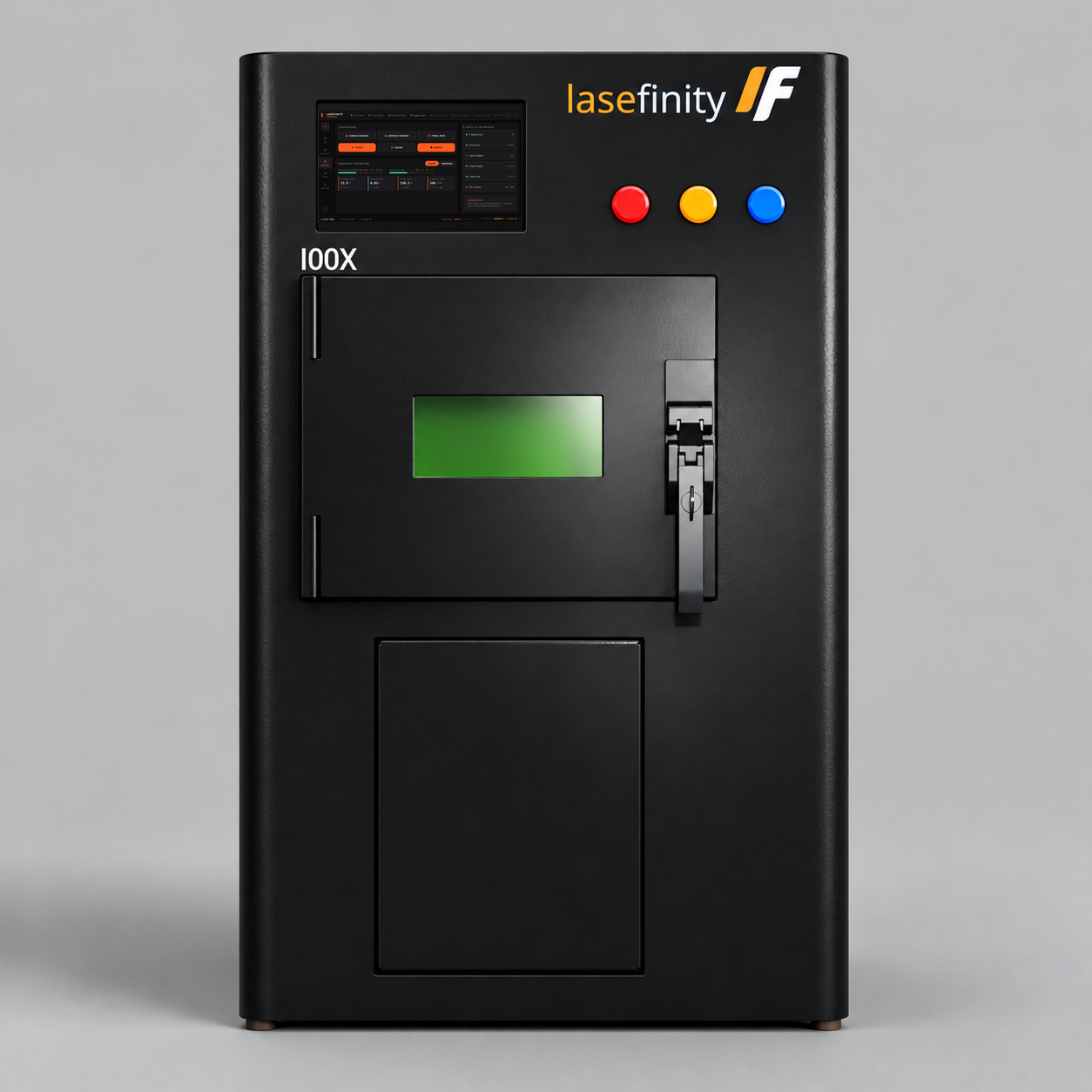
Metal additive manufacturing can demand a large upfront commitment before a buyer knows whether a part will print reliably or justify production. Sheffield machine builder Lasefinity is targeting that gap with two compact systems, the FusionX powder-bed printer and WireX wire-fed deposition machine, each starting at £24,999. Founder and chief technology officer Dr Prveen Bidare sees them as a way for smaller manufacturers and research teams to test applications without beginning with a much larger machine.

That price point speaks to a problem Bidare heard from prospective users: they wanted to adopt metal printing but found the first step too expensive. A production system might cost half a million pounds, he said, while a buyer still faced the possibility that the intended application would not work. The challenge is especially acute for a jeweller or spare-parts maker weighing a purchase before producing a part, learning the process limits or estimating machine demand.
Bidare’s response draws on a research machine that was small enough to carry between laboratories. At Heriot-Watt University in Edinburgh, he built an open-architecture laser powder bed fusion system about the size of a shoebox. Its compact form let researchers take it to X-ray equipment and observe the melt pool as a laser fused metal powder. The apparatus could be configured for a single laser track or a dense, multilayer component, giving the team room to change the setup around the measurement.
Research origins, commercial focus
His interest in additive manufacturing began earlier, while developing applications at GE in Bangalore in 2013–14. He later worked at Siemens. Bidare saw machines becoming easier for operators to use, but remained concerned about the quality of the parts they produced. That mismatch between accessible machine operation and the engineering work still needed to get good results helped shape his doctoral research.
After about 18 months at the Manufacturing Technology Centre in Coventry, Bidare worked at the University of Birmingham and held a senior lectureship. He started Manufacturing Made Easy in 2022 to develop tools and accessories intended to speed up and improve manufacturing processes. Investors familiar with his research encouraged him to build a printer as well. Funding supported prototypes, trials and revisions over the following two to three years. Manufacturing Made Easy continued its research work, while Lasefinity became the machine brand. The team presented FusionX at TCT 3Sixty in Birmingham.
Build size affects the cost of experimentation
A smaller machine changes more than the purchase price. Bidare points to the powder, material, workspace and energy needed to run larger systems. A university testing an experimental alloy may need to load a substantial quantity of powder even if the test specimen is small. A workshop learning whether it has a viable application must also cover the space and operating costs during that period.
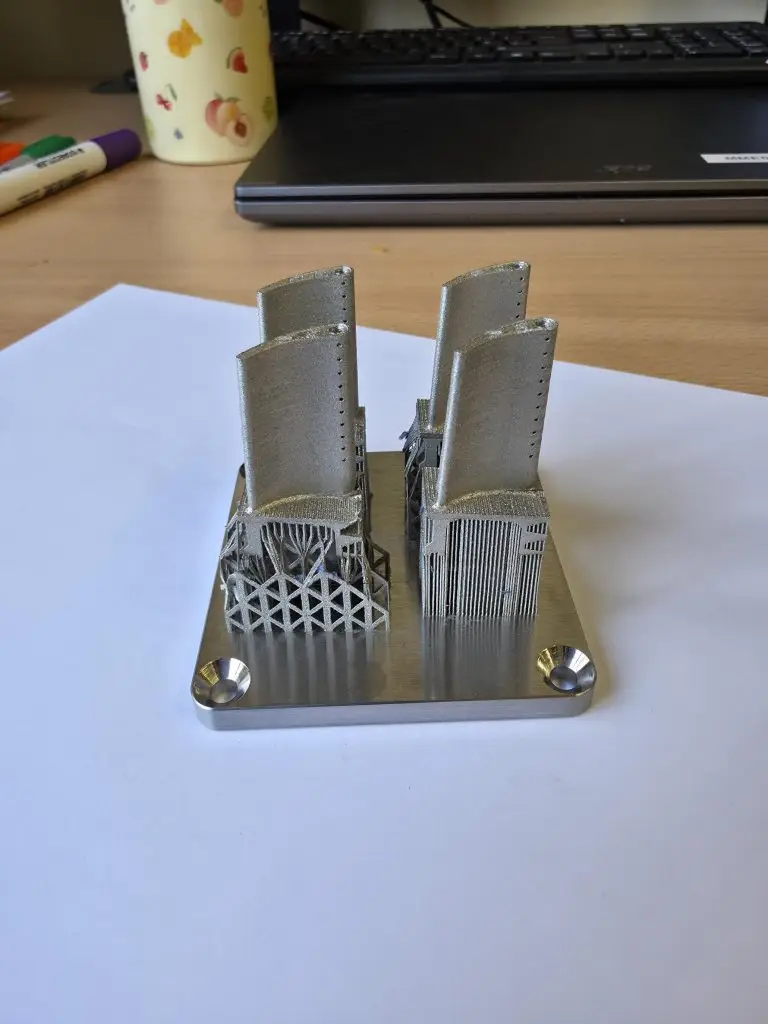
During development, Bidare considered build volumes of 100 mm and 150 mm cubes. The published build volume for the FusionX FX-500 is 100 × 100 × 80 mm. It uses a 500 W fibre laser, with a beam adjustable from 50 to 200 microns. For materials researchers, the ability to vary the energy delivered to the powder and inspect the resulting part offers control over experiments—an aim carried over from Bidare’s doctoral machine.
Powder supply forms another part of the early cost calculation. Lasefinity has tested powders sourced in the UK and material from US producer 6K. Bidare said he had not yet tried Chinese suppliers, though he wanted to, and was also interested in powders from India. His focus is on atomisation method and whether material meets specification. For users still running trials, a lower-cost suitable powder could reduce the expense of learning before a saleable part is available.
WireX trades some precision for deposition speed
WireX addresses a different process trade-off. Powder bed fusion uses a fine beam to scan thin layers, supporting small features but taking time to build them. Conventional wire-fed directed energy deposition (DED) uses a larger beam and thicker wire to deposit metal quickly, but Bidare says the resulting parts lack accuracy. Lasefinity’s approach feeds finer wire into a laser-generated melt pool, aiming to combine deposition speed with more controlled placement.
The wire measures 0.4 to 0.8 mm in diameter, and WireX has a 150 × 150 × 150 mm build volume. An integrated camera lets operators watch the melt pool during deposition. Bidare still considers powder bed fusion more accurate. He sees fine-wire deposition as particularly relevant to repair, where metal can be added locally to a worn surface. An expensive component, such as an aero-engine part, may be worth restoring rather than replacing. The team presented its work on micro-wire deposition for cladding and surface restoration at the 2026 ASTM International Conference on Advanced Manufacturing.
Wire also changes material handling in a shared lab or workshop. Loose powder requires careful handling, Bidare said, because it is flammable and can spread around the work area. Moisture and contamination also matter when powder is stored or reused. Wire supplied on a spool is easier to manage and leaves less loose material after a trial.
Over the next two to three years, Bidare wants Lasefinity to serve materials researchers and smaller industrial firms in Britain and overseas. Its intended role is to help customers establish whether a process works and what they need from a larger system. A manufacturer that learns on a Lasefinity machine and later moves to a faster system from an established supplier fits that plan: the smaller printer is an entry point for testing the process before scaling up.
Formnext is scheduled for 17–20 November 2026 in Frankfurt. Lasefinity lists Hall 12.0, Stand G130.


