ADDMAN’s 81 HP Jet Fusion Printers Put Production Volume and Repeatability in Focus
- Michael Petch
- 461 reads
ADDMAN plans to add 81 HP systems as larger print runs, tighter process control and application-led demand reshape service-bureau economics.


ADDMAN’s planned addition of 81 HP Jet Fusion 5620 Pro systems points to a shift in what additive manufacturing service bureaus are buying capacity for: repeat production, not just prototypes. HP’s François Minec says larger part runs are becoming practical for Multi Jet Fusion (MJF), while improved consistency and control over print settings give bureaus more ways to compete for work.
ADDMAN had already been sending jobs to other service providers as its own capacity fell behind demand. Forecast 3D, an early HP production partner later acquired by ADDMAN, had also outsourced work while investment in its fleet slowed. Minec, HP’s global head of sales and business development for additive manufacturing, described a “very big part” of the new investment as firm but declined to quantify the outsourced volume.
Once installed, the new systems would take ADDMAN’s MJF fleet past 125 machines. The pace of deployment depends in part on hiring operators and expanding electrical capacity. How much existing work returns in-house remains for ADDMAN to determine; the larger industry question is what makes a substantial fleet expansion worth pursuing.
Production runs change the capacity calculation
Minec’s example is a part roughly the size of a fist. A few years ago, a run of 100 might have suited MJF. Depending on the part, he says, a bureau can now consider printing 10,000 and compete with an injection-moulding quote. In his experience, there are many more such runs to bid on. Winning even a handful can make a meaningful difference to the amount of machine time a bureau sells.
Minec estimates that the work he sees at service bureaus has shifted from roughly equal shares of production and prototyping to about 80% production by volume. He links part of that change to a practical improvement from HP’s 5200 systems to the 5600 series: results became easier to reproduce across different printers. That matters when a customer needs parts from a distributed fleet to behave consistently, rather than merely look alike in a sample build.
Ocado, with machines in Mexico, the UK and Sweden, needed to understand how closely output from one printer would match another. Minec said HP worked on calibration across that network. He also acknowledged that the preceding generation did not always meet the consistency some industrial production work now demands. For a bureau, repeatability can affect whether a job is viable across multiple machines and sites.
Powder use and finishing still shape unit economics
Material efficiency is another part of the production calculation. Minec offered a simplified example: for one kilogram of printed parts at 10% packing density and a 20% powder refresh rate, another kilogram of powder is discarded. He said customers now pack builds around four percentage points more densely on average than they did three years earlier. Some use nearly all their powder, though blasting and other process steps can leave material that cannot be recovered.
Those figures don’t establish a finished-part price or a universal cost advantage over moulding. Minec gave no cost for an ADDMAN programme. The comparison depends on how much usable output fits into a build and what it costs to finish each part. Packing density, powder recovery and post-processing all affect the result, so the economics remain specific to the geometry and customer requirements.
Finishing also limits how far print production can run without people. Minec said an HP printer can complete two successive jobs—about 24 hours of printing—without operator intervention. But a bureau producing 20,000 parts a day still needs to remove powder, identify components and route them for different treatments, such as black dye or vapour smoothing. Sorting one large, regular order is a different task from handling a day’s output for hundreds of customers.
Process settings let bureaus define their offer
Minec says operators of the HP 5600 can access 35 process parameters, including agent settings and layer thickness, with HP training customers to use them. That gives bureaus room to tune a process around a job and build a distinct service. One group of customers wanted to move from 90-micron layers to 110 microns. Their parts needed less detail, and the thicker layer could shorten print time. Minec said HP was preparing a high-productivity print mode after enough customers asked for the change.
Other bureaus may accept a longer build to pursue finer detail or particular mechanical properties. When two providers quote on a job using the same printer model, those process choices can help distinguish their results. Surface finish has long been one way to differentiate bureau work; Minec sees a similar role for each provider’s “own print mode, which is their signature”.
Applications can create the next printer order
Minec points to drones and cranial helmets as examples of applications with significant business potential, without disclosing revenue figures. One unnamed drone manufacturer, he said, had been spending eight hours assembling a unit. After working with HP on the design, it could complete assembly in about half an hour. The example shows how additive manufacturing can matter to a buyer when it changes an assembly process, not simply when it produces a part.
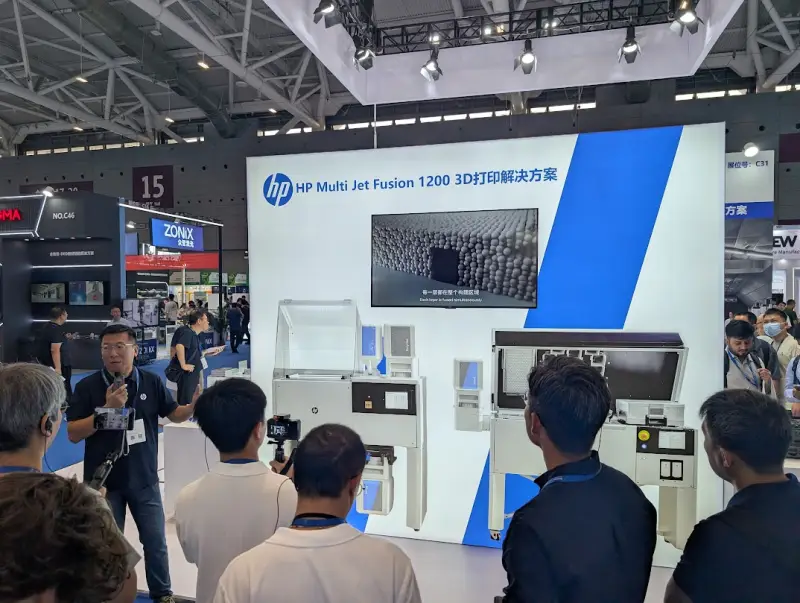
HP expects manufacturers to develop applications on its smaller 1200 printer, then place volume orders with production bureaus. Minec says some customers are already buying systems “by the dozen”. Repeat orders give a bureau a clearer reason to keep machines occupied and add capacity. His sales advice follows from that sequence: “Don’t try to sell printers.” Develop the application with the end customer, he says, and the equipment order becomes easier to secure.
For ADDMAN, the 81-system plan will test whether that application-led demand can support a fleet of more than 125 MJF machines. Staffing, electrical capacity, repeatability and post-processing will all shape how quickly the added printers become useful production assets.