kabkin Reports 100+ Industrial Enquiries for Its Prompt-to-Product Engineering Service
- Adriana Alarcón
- 378 reads
kabkin says its engineering platform has received more than 100 industrial enquiries, but hasn’t disclosed how many have reached production.

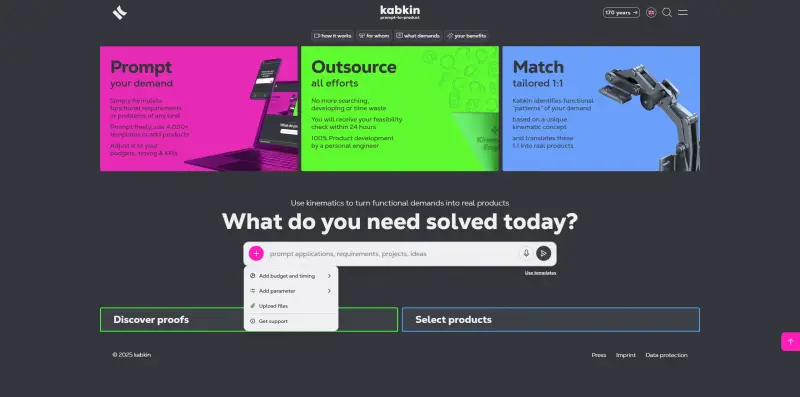
Turning a functional requirement into a manufacturable component takes more than a text prompt. German engineering company kabkin says its Prompt-to-Product platform has drawn more than 100 industrial project enquiries since its current version went live in early 2026. The figure counts enquiries, not completed products or confirmed contracts, so the useful measure will be how many needs progress into engineering work and manufacturing.

The milestone, announced on 21 September, covers business requirements involving mechanical function, movement, installation space, loads, safety, cost and deadlines. Founder Chris Windhövel described the service as starting with what a customer needs a product to do, rather than with a catalogue of available products and suppliers.
Engineering assessment behind the interface
Customers describe the required function and can submit photographs, sketches, technical documents, performance requirements, target budgets and delivery deadlines. kabkin’s engineers review that information to determine whether the need can be met with an existing product, an adapted design or a newly developed mechanism.
Despite its name, Prompt-to-Product doesn’t automatically turn written instructions into computer-aided design (CAD) files. It’s an engineering and manufacturing service accessed through a digital interface, with people assessing the submitted requirements. That distinction matters: a short description can capture what a component must do, but design decisions still depend on motion, forces, available space and how the part connects to surrounding equipment.
kabkin says its engineers use kinematic analysis to assess movement, forces, degrees of freedom, installation constraints and interfaces. They also draw on a database of more than 15,000 previously realized kinematic solutions. That library may help identify a suitable existing design or a starting point for adaptation; the company hasn’t said how often enquiries are resolved through those options rather than new development.
For enquiries it considers qualified, kabkin says it provides an initial engineering feasibility assessment within 24 hours. That assessment addresses technical feasibility, budget and project timing. It isn’t a promise to deliver a finished design or product in a day.
The work can continue from assessment into design, prototyping and industrialization, then manufacturing, quality assurance and delivery. kabkin says it operates conventional machinery alongside laser based processes and 3D printing, and can call on qualified manufacturing partners when required. The company hasn’t identified the additive processes or materials it uses, or said whether 3D printing was involved in any of the 100-plus enquiries. It also hasn’t reported how many enquiries became paid projects, prototypes or delivered products.
Choosing a process around the part
The service addresses a familiar gap in manufacturing: a customer may know the required function without knowing whether an off-the-shelf component will fit, whether a design change is needed or which process can produce the result. Additive manufacturing can suit some customized or low-volume parts, but the choice depends on geometry, material, production volume, required properties and post-processing. In practice, additive and conventional methods can form different stages of one production route.
JOME Engineering’s replacement marine propeller illustrates that combination. The 26kg component had to be recreated without the original CAD files or tooling. JOME digitally reconstructed it using 3D scanning, then produced a near-net-shape part from 316L stainless steel with wire arc additive manufacturing (WAAM). WAAM feeds metal wire into an electric arc, melts it and deposits material in successive passes. Conventional machining and finishing then bring the part to its final geometry.
Material deposition took approximately 20 hours, while machining and finishing took around 100 hours. Equipment manufacturer Caracol reported a 60% reduction in lead time and a 40% reduction in costs against the tooling and casting route. Those reported results describe this particular propeller job; they don’t establish a general performance figure for WAAM. The example shows why process selection includes the full route from reconstruction through finishing, rather than the build method alone.
Polymer powder-bed production offers a different set of process characteristics. Protolabs recently increased its HP Multi Jet Fusion capacity by 50% after reporting more than 40% year-on-year growth in US MJF revenue through the third quarter of 2026. MJF uses printheads to apply fusing and detailing agents to layers of polymer powder. Thermal energy fuses selected regions, and the layer-by-layer cycle builds the parts. It differs from WAAM in material and deposition method, underscoring that “additive manufacturing” covers processes suited to different requirements.
kabkin’s approach puts process choice within an engineering assessment that can consider conventional production, additive methods or a combination. The 100-plus enquiries indicate interest in starting with a functional need, but the available figures don’t show how many moved beyond assessment. The clearest next measure will be the number of designs, prototypes and manufactured parts that result from those enquiries.