Microchip IS2066B Reference Design Covers Bluetooth Stereo Earbuds and Charging Cases
- Nidhi Agarwal
- 748 reads
Microchip’s IS2066B design details earbud modes, call handover, charging-case control and PCB layout for Bluetooth stereo products.
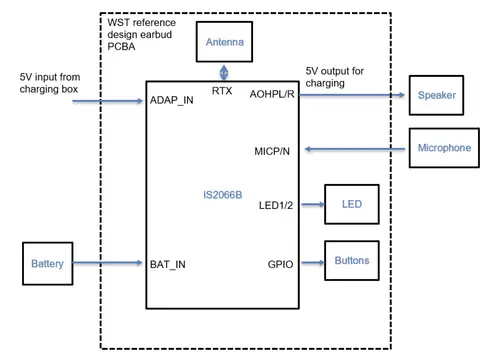
Microchip’s IS2066B Wireless Stereo Technology Reference Design brings earbud behavior, charging-case control and board-level guidance into one hardware package. For teams developing Bluetooth stereo earbuds or headphones, its main value is the defined split between three control modes: embedded operation for standard product behavior, or a host MCU when the design needs more specialized functions.

The design supports stereo streaming through the Advanced Audio Distribution Profile (A2DP), including Advanced Audio Coding (AAC), and voice calls through the Headset Profile (HSP) and Hands-Free Profile (HFP). It also describes pairing and left-right earbud coordination, link-loss handling, microphone selection and single-earbud use. Those functions make the reference useful for working through the system behavior around the audio link, not only the board connections.
Choose the control model around the product
Auto Embedded Mode ties earbud power and reconnection behavior to the charging case. Opening the case and removing the earbuds starts them and reconnects the left and right units. Returning them to the case lets them exchange information and begin charging; they switch off after charging completes. This reduces the need for users to manage each earbud’s power state directly, but it means the case must provide 5V at its charging ports when opened.

Button behavior is configurable in this mode. Three manually operated buttons can be assigned functions such as power, playback, call answer or end, and microphone selection. Two further buttons handle volume and track navigation. The design therefore gives product teams a defined set of control inputs while leaving room to map them to the intended user interface.
Manual Embedded Mode retains similar earbud features but uses buttons to switch the earbuds on and off. It does not depend on the extra charging-case feature required by Auto Embedded Mode. That makes it a fit for designs where case-driven power control is not part of the intended product behavior.

Host MCU Mode is the extension point when the embedded modes do not cover the needed behavior. The listed examples include advanced handover, Bluetooth Low Energy (BLE) communication with a mobile application or another device, and connections to external sensors. The trade-off is architectural: the host MCU allows additional product logic, while adding a processor and its firmware responsibilities to the system.
Call continuity and link management
Single-earbud operation is built into the design’s continuous talk mode. A user can take a call through one earbud, then transfer an active call to the idle earbud. This supports continued use when one side needs to be removed or set aside, and it can extend continuous talk time by alternating which earbud is active.
The design also includes link-loss management for cases where an earbud moves out of range or loses power. Those conditions matter because a stereo product has multiple wireless relationships to manage: the connection to the phone and coordination between the two earbuds. The reference describes reconnection between earbuds and simplified pairing, including an optional automatic pairing process when a device is scanning for connections. Product teams can use these behaviors as a starting point for deciding how the system should recover when a link is interrupted.
Charging-case behavior depends on power timing
A separate case circuit detects earbuds through two charging ports, each with two contacts for an earbud. When the case detects that an earbud has been removed, it can power that earbud on automatically. The case’s internal battery can be charged over a USB connection.

Power management in the case includes detection of a 6–8mA load current and shutdown of the 5V output supplied to the Bluetooth audio chip. Microchip specifies a timing relationship that affects reliable in-and-out-of-case behavior: the chip’s charge-complete delay-off time should be shorter than the case’s low-current detection off time. In practical terms, the two shutdown decisions must occur in the intended order so the case can distinguish charging completion from removal and power transitions.
PCB and antenna guidance
For the PCB, Microchip recommends a four-layer or higher-layer board with a solid ground plane. The Bluetooth audio chip’s centre ground pad should connect firmly to the inner ground plane through vias. This gives the layout a direct ground connection beneath the device, which is a key part of implementing the board as intended.
The antenna placement guidance is equally specific: keep the antenna away from large metal objects, and avoid placing metal shielding around the PCB antenna. These constraints need to be considered early in the mechanical and board layout, since nearby metal and shielding can affect the antenna’s operating environment. The reference does not provide antenna performance figures or a range target, so the final product still needs evaluation in its intended enclosure and configuration.
Design files and implementation scope
Microchip says it has tested the reference design and provides a bill of materials, schematics, an assembly drawing, a PCB layout and additional implementation data. These materials give engineering teams a concrete starting point for reproducing the hardware and adapting it to a product, while the application note documents the IS2066B design in more detail.
The most useful early decision is which control mode fits the product’s expected interaction. Case-driven automation brings convenience but depends on the case’s 5V output and power-management timing; manual embedded operation keeps power control on buttons; a host MCU opens the door to custom handover, BLE links and sensor inputs. That choice shapes both the electronics and the firmware work that follows.
Microchip IS2066B Wireless Stereo Technology Reference Design application note