Arduino Nano XL Link Adds CAN FD, RS485 and Ethernet for Industrial Control
- Ananthu Ashok
- 554 reads
The Nano XL Link pairs a 120MHz Cortex-M33 with CAN FD, RS485 and Ethernet, while a carrier adds screw terminals, RJ45 and DIN-rail mounting.
Arduino’s Nano XL Link brings three wired network interfaces onto a compact development board: CAN FD, RS485 and 10/100Mbps Ethernet. Announced at electronica 2026, it targets industrial and building automation projects where connecting controllers to field devices and existing networks can otherwise require separate communication hardware.

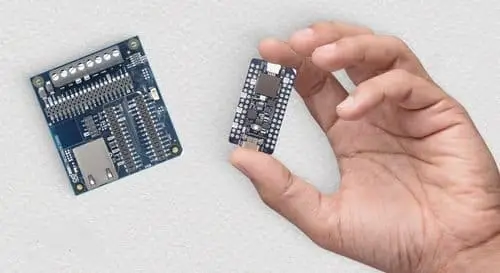
The board’s central device is Microchip’s PIC32CK2051SG01144, built around a 32-bit Arm Cortex-M33 processor running at 120MHz. It includes 2MB of flash and 512KB of RAM. That processing and memory capacity provides the foundation for control logic and communications on the same board, though Arduino has not specified application-level performance, response times or supported network workloads.

Three wired interfaces on the board
The Nano XL Link implements CAN FD with a Texas Instruments TCAN3414 transceiver, RS485 with a THVD2410 transceiver, and Ethernet through a Microchip KSZ8081 PHY. Arduino lists CAN FD speeds up to 8Mbps and Ethernet at 10/100Mbps. Together, the interfaces give a project several ways to exchange data with equipment and infrastructure, depending on the network design and the interface used by the connected devices.

Putting these interfaces directly on the board can simplify prototypes that need to communicate with motors, sensors or building control systems. A designer can evaluate the controller and its wired links without first adding separate communication modules. The practical benefit will depend on the application: the required protocol, wiring arrangement and network configuration still need to match the equipment being connected. The published specifications don’t identify supported higher-level protocols or provide details such as isolation, connector pin assignments or electrical operating limits.
CAN FD supports data rates up to the stated 8Mbps, while the Ethernet PHY supports 10/100Mbps links. Those figures describe interface capability; they don’t establish the throughput of a complete application or guarantee a particular real-time response. System performance will also depend on firmware, network traffic, connected devices and how the application schedules control and communications tasks.

Expansion and installation options
Two 30-pin, double-row connectors expose digital and analogue I/O, PWM, UART, SPI and I2C. A Qwiic connector provides another route for connecting compatible sensors and devices. This combination gives developers access to familiar peripheral buses alongside the board’s wired network connections, making it possible to combine local inputs and outputs with networked control in one design.

Arduino is also offering the Nano XL Link Connector Carrier for applications that need more direct field wiring and enclosure mounting. The carrier provides screw terminals for CAN FD and RS485, an RJ45 Ethernet interface and a DIN-rail mounting option. Arduino describes it as suitable for integration into industrial enclosures of up to 4U size. These features address installation and wiring needs that a bare development board does not, although the available details don’t specify enclosure dimensions, environmental ratings or terminal electrical limits.
The split between the board and carrier gives developers two physical configurations to consider: the Nano XL Link for evaluation and embedded designs, and the carrier for projects that need accessible wired connections and DIN-rail installation. Whether the carrier fits a particular cabinet or control panel will depend on the enclosure and system layout. Arduino has not published further mechanical or environmental specifications in the product details provided.
Software support and intended uses
Arduino says the Nano XL Link can be programmed with the Arduino IDE and Arduino Cloud, and that it supports the Arduino Zephyr core. The company positions the platform for real-time machine control, fieldbus gateway functions, smart lighting, HVAC and energy management. Those are intended application areas; the announcement does not give timing measurements, certification details or reference designs that would establish suitability for a specific deployment.
For developers already working in the Arduino environment, support across the IDE, Cloud and Zephyr core offers several software paths to explore. The relevant choice will depend on how a project handles application code, device management and communications. Teams evaluating the board for a control role will still need to confirm that its hardware interfaces, software support and response characteristics meet their system requirements.
Arduino has not announced pricing or availability for either the Nano XL Link or its Connector Carrier. Those details, along with fuller electrical, mechanical and protocol documentation, will determine how readily the platform can move from development into a finished installation.