Tektronix EA-ELR 21000 Tests 800 V DC Data Centre Power with Regenerative Loads
- Saba Aafreen
- 551 reads
Tektronix’s EA-ELR 21000 simulates fast-changing loads on 800 V DC systems and returns up to 95% of absorbed test power to the grid.
Testing high-power data centre equipment can consume substantial energy, especially when engineers need to reproduce rapid changes in computing demand over extended runs. Tektronix’s EA-ELR 21000 Dynamic Test System addresses both the changing-load requirement and the heat produced by conventional electronic loads. The system is designed to test 800 V DC distribution equipment, including power shelves, racks and solid-state transformers.

The engineering case for dynamic testing is straightforward: a supply system needs to respond when its load changes, not only when it operates at a steady setpoint. AI computing can cause abrupt shifts in power demand, so testing equipment under changing conditions can help engineers assess stability, efficiency and reliability. Tektronix says the EA-ELR 21000 is intended to simulate those conditions for high-voltage DC systems.

Returning absorbed power to the grid
The platform uses an electronic load module to draw power from the device under test and reproduce a programmed load. In a conventional electronic load, much of the absorbed energy becomes heat. Tektronix says its regenerative design can return up to 95% of that energy to the grid. During long test sequences, this can reduce the heat generated by the load equipment and the energy that would otherwise be dissipated.

That changes the test setup’s energy path: power flows from the equipment under test into the load, then most of the absorbed energy is sent back to the grid. The remaining portion is not specified in the product information, and the 95% figure is given as an upper limit. Actual results will depend on the test conditions and operating point.
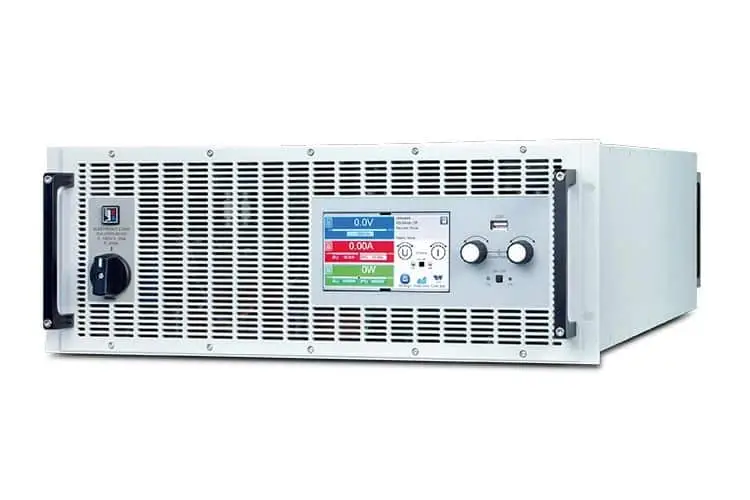
The specified EA-ELR 21000-80 4U HS module can handle up to 1000 V, 80 A and 30 kW. Those ratings give engineers a concrete starting point for assessing whether an individual module fits a test requirement. The system is aimed at 800 V DC applications, while the module’s stated maximum voltage is 1000 V.

Simulating rapid demand changes
For dynamic testing, the load needs to change quickly enough to represent variations in demand. Tektronix specifies current slews of 12 A/µs and describes the system at 240 kW. This capability is relevant when evaluating how power shelves and racks respond to sudden load changes, since a steady-state test alone cannot show their behaviour during a rapid transition.
Engineers can use the load changes to examine whether a power system remains stable as demand shifts, and to measure its efficiency and reliability under those conditions. The published specifications establish the system’s stated slew rate and power scale, but they do not provide test waveforms, response limits or results for particular shelves and racks. Those details would be needed to compare performance across designs or to set acceptance criteria for a specific installation.

There’s a practical distinction between the load’s rating and the equipment being tested: the 30 kW figure applies to the EA-ELR 21000-80 4U HS module, while the larger system is built by combining modules. Matching the configuration to the equipment under test therefore means considering the test power required as well as the voltage and current demands.

Scaling the test capacity
The modular system is specified at 240 kW per rack, with expansion in 30 kW increments. Tektronix says up to eight racks can be combined to provide a total capacity of 1.92 MW, using 64 loads. This lets a test facility build capacity in stages or configure a larger installation for higher-power equipment.
Individual modules can also be serviced, according to Tektronix. In a modular test system, that serviceability can help teams work on a particular unit without treating the entire rack as a single component. The product information does not describe service intervals or maintenance procedures, so those details will need to come from the equipment documentation.
The EA-ELR 21000’s main contribution is a combination of fast load changes, high-voltage DC capability and regenerative operation. For engineers validating 800 V distribution hardware, the important next step is to compare the module and rack ratings with the intended test profile, then establish the measurements needed to judge the equipment’s response. Tektronix provides further product information on its EA-ELR 21000 announcement page.