Nuvoton Gerda and Qt for MCUs Target Memory-Efficient HMI Graphics
- Saba Aafreen
- 612 reads
Gerda pairs internal RAM with Qt for MCUs and texture compression to support graphical interfaces without external memory.

Rich graphics on an embedded display can bring a hardware cost with them: external memory, its board space and the components needed to connect it. Nuvoton Technology Corporation Japan (NTCJ) and Qt Group are combining Nuvoton’s Gerda HMI controller platform with Qt for MCUs to target interfaces that need more visual detail while keeping external memory out of the design.

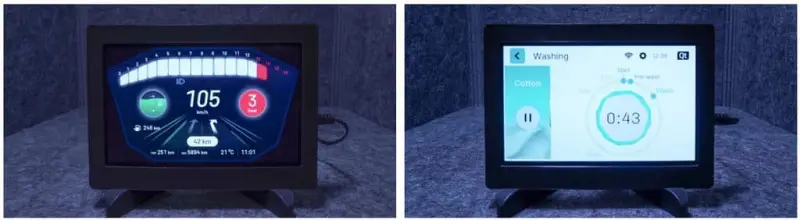
The companies cite motorcycle instrument clusters, head-up displays and washing machine panels as applications. The practical appeal is straightforward: designers can build touch interfaces with graphics and animation while using Gerda’s internal RAM. The announcement describes a hardware and software pairing; it does not specify a memory capacity, display resolution, frame rate or supported panel interfaces, so product teams will need platform-level details to judge fit for a particular screen and workload.


Graphics and memory are designed together
Gerda supplies the controller platform, internal RAM, and display, connectivity and control interfaces. Qt for MCUs contributes the graphics engine, reusable components and development environment. The stated approach also uses Qt graphics optimized for Gerda’s texture compression, reducing the memory required to represent graphics and animation.

That coordination matters because an interface is not just a collection of static screens. Fonts, icons, transitions and animated elements all draw on a limited memory budget, and the available resources must serve the rest of the embedded application too. Texture compression can reduce the space graphics occupy, while the controller’s internal RAM removes the need for a separate memory device in designs that fit the platform’s limits. The announcement gives no compression ratio or workload measurements, however, so the actual memory savings will depend on the content and implementation.

For a production design, engineers will still need to check that the available memory can accommodate the intended assets and runtime behavior. They will also need to confirm display timing, interface compatibility, touch input behavior and the controller’s resources for application tasks. The announcement does not publish those specifications or identify a specific Gerda part number. Its central claim is architectural: a matched controller and graphics stack can support richer HMI work within an internal-memory design.
What the software brings to interface development
Qt for MCUs includes pre-built components, a development environment and QML, the language used to describe the interface. Nuvoton and Qt also point to simulation tools and AI-driven tools intended to reduce development effort. In practical terms, reusable interface elements and simulation can help teams assemble and inspect screens before committing to the final embedded build. The announcement does not quantify the time saved or describe the AI tools’ functions, so those claims should be assessed against a team’s existing workflow.

A shared graphics stack can also help keep the design process aligned with the target hardware. Interface assets that look acceptable in a desktop preview still need to fit the embedded controller’s memory and rendering resources. Here, the stated collaboration links Qt’s graphics capabilities to Gerda’s texture compression and internal memory. That gives developers a defined platform to evaluate, though it does not remove the need to measure the finished interface on the intended display.

Updates add a connected-product consideration
The companies say the solution supports over-the-air (OTA) updates for changing graphical interfaces and adding features. They also describe Gerda’s security features as working with Qt for MCUs to enable this capability. For connected vehicles and household appliances, the prospect of updating the interface after installation can affect how teams plan software maintenance and feature delivery. The announcement does not detail update signing, rollback behavior, storage requirements or security protocols, so those implementation details remain important questions for system designers.
Yoshihide Kanakubo, Nuvoton’s vice president for Battery and Automotive BG, said the combination is intended to balance graphical performance, memory efficiency and system cost. NTCJ and Qt Group announced the pairing on November 13, 2026. For engineers assessing it, the key next step is to compare the target interface’s memory and display requirements with Gerda’s published specifications, then verify the complete graphics workload on the chosen hardware. The approach may simplify a cost-sensitive HMI bill of materials when its internal resources are sufficient; the public details provided so far do not establish the limits of that fit.
Nuvoton’s product announcement provides further information about the Gerda and Qt for MCUs combination.