ISO 21423 Sets a Common Communication Framework for Industrial Mobile Robots
- Hannah Shapiro
- 329 reads
ISO 21423 extends AMR interoperability across robots, fleet managers and facility systems, building on MassRobotics and VDA 5050.
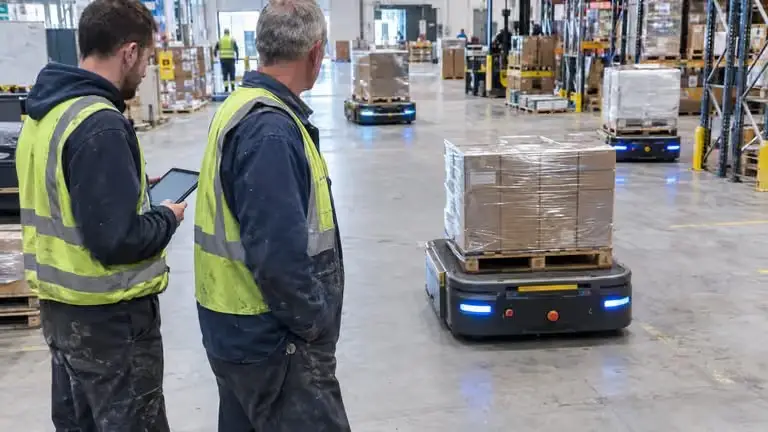
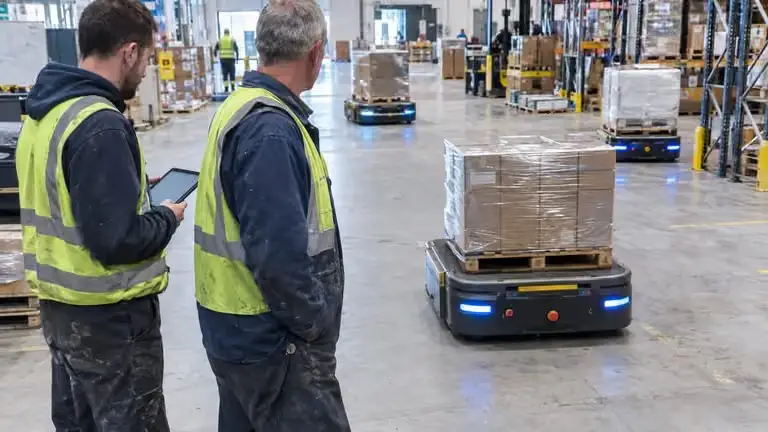
ISO 21423:2026 gives industrial mobile robots from different vendors a shared framework for exchanging operational information and requesting actions from other systems. Published after work by ISO Technical Committee 299, Working Group 10, the standard builds on two existing approaches: MassRobotics’ interoperability specification and Europe’s VDA 5050. Its practical test will be whether facilities can coordinate mixed fleets with less custom integration.
The scope goes beyond messages passed between robots. Mobile robots, fleet managers and other equipment can share information about location, speed, direction, condition, tasking and availability. The standard also covers communications with systems and devices such as lifts, automated doors, alarms, enterprise resource planning (ERP) systems and workers carrying mobile devices. That broader reach matters on busy sites, where a robot’s route and task can depend on equipment and people beyond its own fleet.
Starting with the information robots need to share
The work began in 2020, when MassRobotics convened its AMR Interoperability Working Group. The goal was to help organizations use autonomous mobile robots from multiple vendors in the same warehouse or factory. End users were already testing mixed fleets, and no single robot provider could meet every operational need. Contributors included robot vendors, engineers and end users, among them FedEx, Procter & Gamble and DHL.
For its first specification, the group kept the required data set deliberately focused. Robots needed to communicate basic operational details: where they were, how fast they were moving, which direction they were heading, their health and whether they were available. Sharing those signals gives other robots and fleet systems information they can use to coordinate movement and work.
The group published that specification in 2021 as an open-source standard. Its materials remain available through the MassRobotics publication page and the project’s GitHub repository. A trial at a FedEx facility put robots from Waypoint Robotics, Vecna Robotics and other vendors in the same operating space. That early deployment gave the effort a concrete use case: make essential status information available across vendor boundaries.
Combining established approaches
ISO 21423 draws on the MassRobotics specification, which had been piloted in North America, and VDA 5050, which has been widely adopted in Europe. The international working group included nearly 90 participants from more than a dozen countries. Members of Germany’s VDMA helped keep the two approaches aligned during development.
The choice of MQTT and JSON also connects the standard to technologies already used in industrial data exchange. Facilities implementing the MassRobotics specification are therefore starting from familiar foundations, although the precise work needed to meet ISO 21423 will depend on their existing systems and implementations. A shared data format can reduce translation between vendors, but interoperability still depends on systems exchanging and interpreting the required information consistently.
The standard’s wider scope reflects how mobile robots operate in practice. A robot may need to coordinate with a lift or automated door, while a fleet manager may need to exchange information with enterprise systems or devices carried by workers. Giving those interactions a common communication framework can help facilities connect more parts of an operation without designing every interface from scratch.
What facilities may gain from adoption
For operators, the intended benefit is coordination across mixed fleets: fewer robots obstructing one another, fewer stoppages that require people to clear a jam, and higher robot availability. A common framework may also give facilities more room to select robots for particular jobs without repeating a full round of custom integration for each vendor. These are expected operational gains, not results guaranteed by the standard alone; performance will depend on implementation and the demands of each site.
ISO 21423 is described as the first non-safety robot standard that the Association for Advancing Automation (A3) has helped produce. Its publication marks a shift from a focused, open-source specification toward an international framework with a broader set of systems in scope. The next measure of its value is adoption: whether robot suppliers, fleet managers and facility equipment makers implement compatible communications in real deployments.
For engineering teams planning mixed fleets, the key question is how existing interfaces map to the new requirements and which connected systems fall within their deployment’s scope. The shared foundation is now defined; the day-to-day gains will depend on how consistently the industry puts it to work.