Hydra CHAMP Combines Ceramic Printing, Machining and In-Process Defect Repair
- Michael Petch
- 516 reads
Hydra’s CHAMP platform prints, dries, machines and inspects ceramic parts, then can rework defects before later layers hide them.
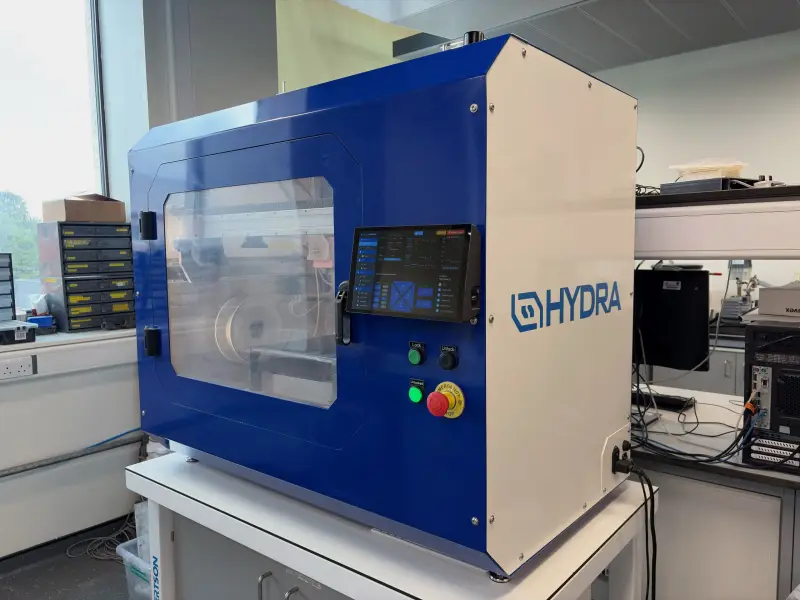

A ceramic printer that can correct a flawed layer before building over it changes the economics of process control as well as part design. Hydra Manufacturing’s Ceramic Hybrid Additive Manufacturing Platform (CHAMP) combines paste deposition, drying, machining and inspection in one machine. Its central idea is straightforward: inspect a deposited layer, remove excess material or cut back a faulty section, then continue printing while the defect is still accessible.
The repair function grew from doctoral research at the University of Leeds. Chief executive Louis Masters needed images of printing defects to train a machine vision system to recognise them. As the team improved the printer, defects became less common, so researchers began introducing them deliberately. Masters says he labelled thousands of images by hand, marking areas where the printer had laid down too much or too little paste.
Recognition was only part of the problem. Most 3D printers can detect a flaw but cannot correct it once it has happened. The Leeds system paired its extruder with a milling spindle, allowing it to cut back to the previous layer when a deposit fell short. It could then rewind the print instructions and attempt the layer again before subsequent material concealed the error. In tests published in Additive Manufacturing, CT scans found 68% less void content in reworked specimens than in uncorrected specimens. That result describes those test pieces; performance on a customer’s fired component will depend on its material, geometry and tolerance requirements.
One machine handles several process stages
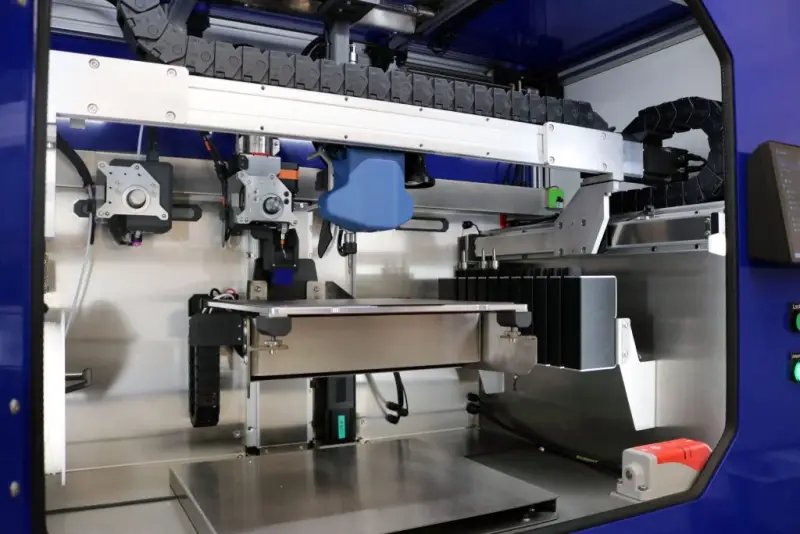
CHAMP’s combination of tools also addresses a manufacturing constraint: some surfaces are easiest to machine before the rest of a complex shape surrounds them. The machine can deposit and dry part of a component, cut an exposed surface, and then resume building around it. Machining only after printing may be impractical when the cutter cannot reach every surface.
There is also a cost argument for cutting ceramic before firing. Masters estimates that grinding or machining can account for as much as 80% of the cost of a finished product in demanding applications involving wear-resistant materials such as silicon carbide. In the unfired, or “green,” state, binder holds the ceramic particles together, leaving a weaker body that can be cut with less costly tooling. The process aims to finish more of the surface at that stage and reduce the grinding required after sintering.
That approach shifts some of the dimensional challenge earlier in production. A surface cut to size in the green state can change as the part dries and shrinks during firing. Hydra’s software enlarges the starting geometry to account for sintering shrinkage, adds machining stock and adjusts layer heights for drying shrinkage. Masters says a consistent feedstock produces reasonably repeatable material behaviour, while the team continues to validate how accurately fired parts hold their intended dimensions across different geometries.
The same spindle supports the defect correction system. If inspection finds excess paste, the machine can skim it back to a reference height. If material is missing, it can remove the faulty layer and print it again, adjusting extrusion pressure to help prevent the same error from recurring. Those functions put inspection and correction within the build sequence, where a problem can be addressed before later layers make it harder to reach.
Designed around existing ceramic materials
Hydra’s target users are manufacturers that already know how to prepare and fire their ceramic feedstock. Paste extrusion gives them a shaping route that can work with familiar materials, mixing equipment and furnaces. It may also suit dark ceramics that are difficult to formulate for light-based curing, since the process does not require customers to introduce a photosensitive resin into their production line.
Hydra links its cycle time to feedstocks with lower binder content. Masters describes a typical sequence in which a printed part dries overnight, followed by binder removal and sintering in a single furnace cycle. That cycle can take about 18 hours, or around 24 hours including cooldown. He contrasts this with some photopolymer-based ceramic builds, where binder removal alone can take five days to limit cracking. Light-based processes still have an advantage for very fine features and intricate geometries. For simpler shapes, a shorter furnace schedule may matter more than higher resolution.
Drying between deposited layers can be the slowest step within CHAMP. The early laboratory machine used forced air; Masters recalls that a previous doctoral student even listed TRESemmé as a supplier for the dryer. Masters and colleague Dan Davie later switched to infrared drying, which he describes as faster and more even. They also adopted a two-stage extruder developed for clay, in which a ram feeds paste into an auger. Hydra has since made its own extruder for finer control of material flow and, according to Masters, filed a patent application for that design.
From laboratory rig to first customer
The research began at Loughborough before the team moved to Leeds. An industrial sponsor wanted to test whether a more complex ceramic shape could improve one of its components, and Professor Robert Kay secured support that helped fund Masters’ doctorate. The researchers deployed a machine in industry before forming Hydra, though restructuring at the customer later ended that relationship.
The early rig earned the team the nickname “Frankenchamp.” Ceramic debris wore down the exposed lead screws that moved its stage, while the original paste extruder also wore quickly under abrasive loads. These problems helped shape the commercial machine’s development: the combination of material handling, drying, machining and inspection had to work as an integrated production system, not just as a laboratory demonstration.
Lucideon, a materials development company, became Hydra’s first machine buyer. After seeing the tools work together at Leeds, Lucideon offered to buy a machine, providing match funding for a grant. The order came about seven days after Hydra registered as a company, following discussions that had begun earlier. Masters says the machine’s complexity is deliberate: the equipment carries the process burden so manufacturers can work with new shapes while retaining familiar materials and downstream operations.
Customer trials shape the next sale
Hydra invites prospective customers to submit their own material for printing trials. The team reports how the formulation behaves and produces test coupons with features drawn from the customer’s component. A successful trial can develop into a larger engineering project or a machine order. Hydra is also exploring rentals. Masters says external users have made different use of CHAMP from its inventors and requested features the team might not otherwise have prioritised.
Hydra initially expected interest from aerospace, medical and energy manufacturers. Masters says much of its work so far has come from electronics and other industrial projects, including work with conductive and insulating materials. Qualification remains a hurdle for a young supplier; at the time of the interview, Hydra’s silicon carbide formulation was in the final stages of qualification.
At Formnext 2026, Hydra plans to show alumina, tungsten carbide and hydroxyapatite samples, along with video of the commercial machine correcting a defect. Hydra and FastCast Ceramics are scheduled to discuss porous ceramics for casting on Tuesday 17 November at 14:00 CET in Hall 12.0, Stand F139. Lucideon is due to speak at the same stand on Wednesday morning about ceramics for extreme environments. Its experience using CHAMP for a year and a half gives prospective buyers an account of how the platform performs with materials and workflows beyond the inventors’ own.


