Holdson Uses Electrochemical Polishing to Finish Metal 3D Printed Parts
- Michael Petch
- 609 reads
Holdson’s Electroform systems target internal passages and rough surfaces, with polishing cycles designed to reduce finishing time and preserve printer capacity.

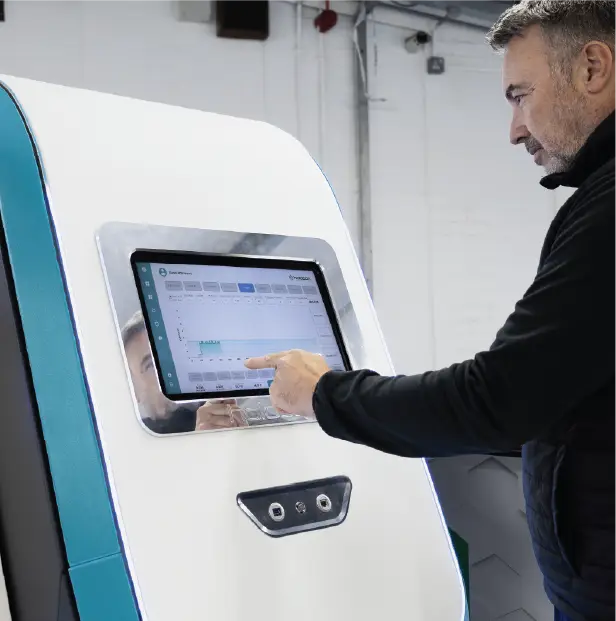

Metal additive manufacturing can produce internal passages that are difficult to finish after printing. Holdson’s electrochemical polishing process is aimed at that gap: it can smooth accessible surfaces inside a component while giving manufacturers another way to balance printer time against finishing time. The key design question comes early. As Paul Tickle of Holdson puts it, the electrode has to be able to reach the surface, and electrolyte has to move through the passage.
Holdson, founded in West Yorkshire in 2023, builds Electroform polishing machines and provides small-batch finishing services. Metal additive manufacturing accounts for an estimated 60% of its business, according to Tickle. Aerospace makes up most of that work, with Inconel and titanium among the materials he encounters most often. The company’s route into the field began with an earlier project involving Cummins, focused on improving the internal finish of turbochargers. That work also showed potential for the method on cast, formed and machined parts.
Polishing inside a channel
Holdson says it can process passages around 2 mm in diameter, provided the electrode can reach the area and electrolyte can flow through it. Diameter alone doesn’t establish whether a channel is suitable: its length, bends and access points all affect the practical limits. That makes the process relevant to printed geometries, but it also means designers need to consider finishing access alongside the shape they want to build.
Electrochemical polishing uses the component as the anode. Current passes through an electrolyte between the workpiece and a second electrode, dissolving metal preferentially at surface peaks. The effect is to reduce roughness by removing high points. Holdson’s machines contain the bath in a standalone unit; Tickle describes the electrolyte as mainly water, with salt-based compounds and additives selected for the material being processed.
For a typical metal AM surface starting at an average roughness of Ra 10–15 µm, Holdson says it can reach below 5 µm Ra in about 20 minutes. Longer cycles can take some surfaces to around 1 µm Ra. These are reported results, not a guarantee for every geometry or alloy: the starting surface and material affect the outcome.
Surface roughness and dimensional change need separate consideration. Tickle puts the amount of metal removed at a few microns to around 300 µm, depending on the initial condition. A rough electron-beam-built surface may require more removal than a machined one. Engineers therefore need both a finish target and an allowance for material loss when setting up a part.
Building a process recipe
For a new component, Holdson uses computational fluid dynamics to estimate how electrolyte will move around and through it. The resulting map predicts where material removal is likely. Operators can change part orientation, control flow by switching tank nozzles on or off, and mask selected features. For an internal channel, however, flow modelling can’t solve an access problem: the electrode still needs a path to the surface.
The system combines an initial Ra measurement with the component’s STL file to estimate the surface area and calculate a processing time. After the cycle, an operator measures the finish and records whether the target was met. If the surface remains too rough, the part can go back into the bath, with the additional time used to refine the recipe. Over repeated runs, those results provide a process record for the same material and geometry.
Holdson offers two machine sizes. The EF-150 is intended for smaller components and research applications, with a nominal envelope of 100 × 100 × 100 mm. The EF-300 handles parts up to 250 × 250 × 250 mm. A finish measurement is only one part of production verification: customers may also compare the component before and after treatment, check critical dimensions on a coordinate measuring machine, run tensile tests or use CT scans to inspect internal features and look for cracking. The checks depend on the application.
Trading print time for finishing time
Tickle’s case for electrochemical polishing starts at the design stage. A manufacturer can use finer print layers to improve the surface directly, but that ties up the printer for longer. If the electrode can reach the relevant features and the design leaves enough material for removal, the team can instead accept a rougher as-printed surface and finish it afterward.
Tickle describes a possible trade: accept 10–15 µm Ra from the printer, then spend half an hour to an hour polishing, instead of aiming for 5 µm Ra during printing. In some cases, he says, that could save several hours of printer time. The practical value depends on the part, the finish required and the full inspection route. Once the polishing cycle ends, the machine lifts the component from the bath, where it can remain until an operator is available to unload it.
Holdson describes Electroform as typically six times faster than competing equipment, but the comparison isn’t tied to a specific alloy, geometry or finish target. For a production decision, the relevant measure is the complete route for the same part: printing, polishing and inspection. The potential gain is greater use of printer capacity, especially where the printer is the constrained or expensive step.
Materials, scale and next steps
Alongside nickel alloys and titanium, Holdson has worked with aluminium alloys including AlSi10Mg and Scalmalloy, as well as pure copper and some precious metals. Tickle also describes work with tungsten for the energy sector and the UK Atomic Energy Authority. He says the process reached around 1 µm Ra on tungsten within an hour. Vibratory finishing can polish tungsten too, but retaining sharp edges and fine features is a concern; Tickle points to edge retention, repeatability and speed as reasons to investigate the electrochemical approach.
Polishing transfers removed metal into the electrolyte, raising a recovery question for customers processing valuable feedstock. Holdson aims to collect spent electrolyte, recycle it and return it to use, with a target of roughly a year from the interview, or late 2027. Recovering valuable metals from the liquid is a separate project planned for 2027.
Tickle expects the installed machine base to reach double figures by the end of 2026, with a goal of tripling it in 2027. Manufacturers in the US and Europe have discussed potential purchases of double-digit machine quantities, while production volumes under discussion range from hundreds to thousands of parts annually. These are prospective conversations, rather than completed orders.
Some enquiries concern parts one metre to 1.2 metres long. Holdson’s modular design offers a route to larger frames and tanks, but handling heavy parts is a central challenge: loading and unloading needs to avoid keeping an operator tied to the machine. The company is prioritizing larger platforms and more automated handling, while Tickle also identifies electroplating and vapour smoothing as processes he would like to explore.
At Formnext in Frankfurt, scheduled for 17–20 November 2026, Holdson plans to show an Electroform machine, sample parts and a separate software station for loading an STL file and reviewing how the component could be processed. For engineers evaluating a printed part with a difficult internal passage, the useful starting point is whether the electrode can reach the target surface—and whether the design accounts for the material the process will remove.


