Renishaw’s Metal 3D Printing Case: Faster Builds, Fewer Supports and Repeat Orders
- Michael Petch
- 779 reads
Renishaw points to Domin’s second printer as a sign of production demand, while TEMPUS and LIBERTAS target build time and support costs.

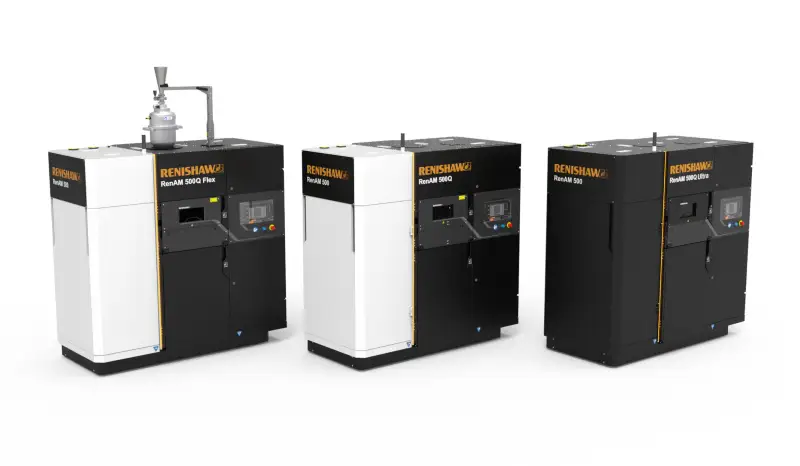

A second metal 3D printer is easiest to justify when the first one is already making a product customers need. That’s the clearest lesson from Domin’s investment in another Renishaw system: the Pucklechurch, near Bristol, valve maker added a RenAM 500Q Ultra in 2024 after installing a four-laser RenAM 500Q the year before. Its problem had shifted from proving a design could be made to producing enough of it.
Domin and Renishaw began working together in 2019 to move Domin’s valve designs into production. The valve body is additively manufactured, according to Renishaw’s Ed Littlewood, because the required design and performance would not be achievable another way at a sustainable cost. When demand exceeds the first machine’s capacity, a follow-on purchase has a direct production rationale. More printers could also let a business spread output across sites as it grows.
From application support to production demand
Renishaw entered metal additive manufacturing in 2011, acquiring MTT after already working with its equipment. Dental parts were an early area of activity, followed by other medical devices. Those applications taught the company that owning a printer does not, on its own, put a part into production. Customers need help adapting a design, preparing the machine and fitting the build into their manufacturing process. Renishaw developed that application support in Britain and through overseas subsidiaries.
That work still matters, but business development manager Ben Deary says buyers increasingly arrive familiar with additive manufacturing as a way to make production parts. The discussion can move sooner to the particular component: whether printing on a given machine suits its design, requirements and production case.
Littlewood credits wider market changes as well as Renishaw’s own work. Medical devices remain an established area, while aerospace is among the faster-growing opportunities he identifies. Energy applications can have similar requirements. Consumer electronics is earlier in its adoption, though interest in cooling computers and data centres has prompted questions about metal printing.
For a machine builder, the distinction between an interesting prototype and a saleable product is central. A product that depends on a printed geometry can create recurring demand for machine capacity. Yet the machine’s nominal capacity is only part of the calculation. Build time, support removal, available floor space, downstream assembly and inspection all affect how much finished product a customer can deliver.
Using the build volume more productively
The RenAM 500 series has a nominal build volume of 250 × 250 × 350 mm. Renishaw’s first major productivity step on the platform was moving from one laser to four, with each laser able to reach the full powder bed. Its next focus was the time lost between operations.
In a typical sequence, the machine spreads a fresh powder layer before the lasers expose it. Renishaw’s TEMPUS software coordinates the lasers and recoater so some operations can overlap. The company says the approach can save up to nine seconds per layer; across a tall build with many layers, those repeated intervals add up. Littlewood said build times could fall by as much as half in some applications.
The practical value depends on the job. Filling more of the plate’s width and depth can increase the number of parts in a batch, while using more of its height means additional layers and longer machine time. TEMPUS is intended to improve the economics of those taller builds by reducing the repeated wait between spreading and exposure. It gives manufacturers another way to make use of the 350 mm build height, although the geometry and production requirements still determine whether a taller arrangement makes sense.
Support structures are another limit on usable capacity. They hold parts in position and help carry heat away during printing, but they consume material and build time. Afterward, they must be removed, and their attachment points can leave surfaces that need finishing. Renishaw’s LIBERTAS software targets that burden by adjusting laser energy for downward-facing surfaces.
Changing exposure settings before printing
Renishaw previewed LIBERTAS at Formnext and has since released it within its QuantAM build preparation package. During preparation, the software examines the local surface angle and varies the prescribed laser energy as the overhang slope changes. Renishaw reports support reductions of 50% in some applications and 80–90% in others. Littlewood stressed that the outcome depends on part geometry, and that support can represent very different proportions of the metal used in different builds.
Littlewood said the company had not seen trade-offs in surface quality, tolerances or mechanical performance so far. That does not mean every support can be removed. Parts still have to manage heat during the build, and some features benefit from keeping support material in place to conduct heat away or steady the geometry.
For manufacturers qualifying a process, the timing of LIBERTAS’s adjustment is significant. QuantAM writes the exposure instructions into the sliced build file before it reaches the machine. Laser power varies across regions of the part, but the instructions are fixed for that build. An engineer can run the same file again with the same settings for each overhang. The software is licensed by QuantAM seat, and files prepared on one seat can run on multiple compatible machines, offering a way to apply the method across an installed fleet.
Output depends on the whole production line
Renishaw’s pitch against machines with more lasers or lower purchase prices includes the space and support needed to operate them. A manufacturer may have funding for another printer but no suitable room; extending a factory can change the economics of the purchase. A compact machine can make a stronger case if it produces enough saleable parts within the space already available.
Service response also affects output. A machine waiting for repair takes up floor space while production stops and depreciation continues. Littlewood calls this the “cost of not making stuff.” Renishaw’s additive sales effort currently focuses on Europe and America. He says competition from China and elsewhere pushes the company to improve its offer.
Even a successful print does not guarantee a finished product on schedule. Deary points to bought-in parts such as circuit boards that may hold up assembly after printing is complete. In aerospace, he sees inspection and verification as a persistent constraint: a faster build gets the part to inspection earlier, but delivery gains depend on how quickly the part can be checked and released.
That is why Renishaw presents additive equipment as part of a production line. Its Formnext manufacturing cell pairs additive manufacturing with an Equator-X gauging system, following a demonstration the previous year that combined printing, machining and measurement. Renishaw Central can monitor an additive machine alongside other Renishaw systems. Littlewood sees its strongest fit among higher-volume customers, though many manufacturers already use their own shop-floor monitoring tools.
Applications and the supply chain
At Formnext in Frankfurt, Renishaw plans to show watch casings, spinal cages and heat sinks to illustrate LIBERTAS applications. One group comprises parts whose support material or removal labour made production uneconomic. Another includes parts that already make sense to print but could be produced in greater numbers per build. The company also plans to show a turbofan engine demonstrator made by a Renishaw colleague and a long-life filter intended to extend change intervals on busy machines.
Other exhibits will come from Renishaw product teams outside its additive division. Under the “AM for All” theme, the company will show parts those teams developed using additive manufacturing, in some cases to reduce cost and in others to secure supply. Incorporating a product logo directly into a part can also matter to the team selling it.
Deary sees British manufacturers showing interest in bringing production closer to home, but says relatively few customers currently operate at the volumes that make the economics work. Littlewood adds that local production depends on local suppliers: a factory can return before the businesses that once supplied it do. Domin’s second printer in Pucklechurch shows the conditions that can support another machine—a product built around additive manufacturing, customer demand and enough work to keep the added capacity productive.


